Queer Undertaking
A queer double bill by choreographer Joel Bray in DADDY and dance collective Sticky Productions in OOZE overtake Dansens Hus during Oslo Pride 2026
The transition from spring to summer in Oslo is always felt by Pride. Rainbows frame the capital up until the Pride Parade, annually held on the last Saturday, in commemoration of the Stonewall Uprisings of the 28th of June, 1969. Only the National holiday on the 17th of May rivals the attendance of the Pride Parade, with approximately half the city either watching or walking the Parade.
The national stage for dance, Dansens Hus, has a tradition of highlighting queer artists, choreographers and performances on the last leg of June. For the beginning of the Pride Festival, Dansens Hus has curated a double bill consisting of the opening act OOZE by the Norwegian company Sticky Productions and the visiting production DADDY by Aboriginal performer and choreographer Joel Bray.
“The Tongue is a Slug”
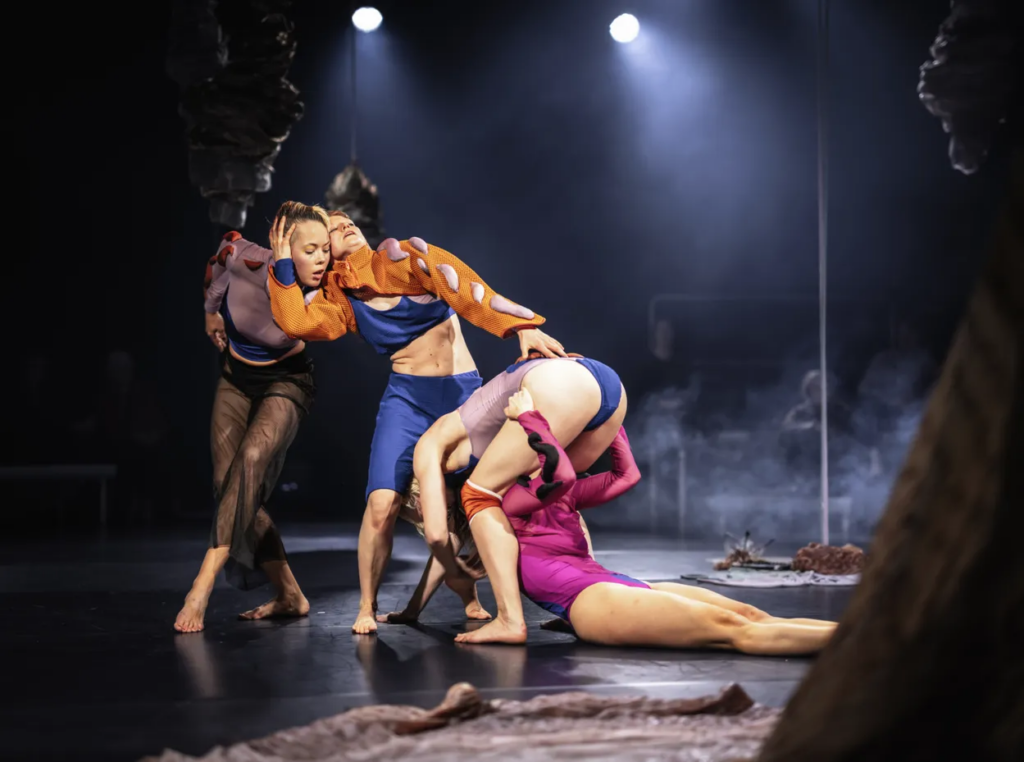
In OOZE, the lesbian dance collectiveholds a microscopic focus on slugs and their intricate mating rituals. This is typical of their biophilic signature, such as their inaugural performance, the critically acclaimed Økohelter (read the review of it in the children’s arts journal Periskop). Dressed in bold colored swimsuits and leotards covered by protruding brown slugs, they enter the Studio Stage two-by-two: one standing, supporting the other dancer who is hanging on for dear life by her legs over the shoulders. The performance continues in these technically demanding and seemingly uncomfortable positions. They end up morphing themselves into one giant mollusc, first ‘bareback’ and secondly covered by a beige-colored sheet. The performance culminates by leaving a streak of wet lubricant that resembles aloe vera behind themselves. They enhance the sensibilities by drenching themselves completely in the gel, and using the slip-and-slide-motion of the liquid to glide and grind across the stage that are equally gross as erotic. Sticky Productions captured the intertwining essence of the slugs ‘slime dance’ captivatingly. “The tongue is a slug” is repeatedly said by a seated speaker (is it sound designer Benjamin Fjellman?) in the dark, merging the overlapping pleasures of food and sex simultaneously.
These aesthetics of mating are both erotic and intersex, as each individual slug possesses both testes and ovaries. Despite being able to self-fertilize without a partner, slugs prefer the slime dance in order to exchange genetic material. That sensibility of collaboration is echoed in the highly shared efforts of the dance collective.
Reconciliatory process
Dansens Hus has shifted its attention to Australian performances this season. First, by hosting the environmentalist indigenous performance U>N>I>T>E>D this April (read the Norwegian review here “Geriljadanser som roboter”). And secondly, by showcasing Joel Bray’s DADDY, the second performance in the Oslo Pride lineup. This unapologetically gay and proudly Aboriginal artist of the Wiradjuri people, uses his own intergenerational and personal story in a performance oriented around his stream of consciousness concerning his identity. Despite being at the Dansens Hus main stage, the amphitheatre is not in use, as we are encapsulated by black curtains on the actual stage. Bray is in a pink boxer reclined on a pink taffeta bed. Other than frequent use of crowd participation, the man of the hour carries the entire play as performer, choreographer and director.
The Pleasure Is Ours
In one instance, yours truly holds up the placard background to Bray’s several tableaux vivants. He poses once as an angel while an unsuspecting audience member holds posters shapeds as wings behind his back, and another as the Greek God of ecstasy, Dionysius, while one audience member fans him and another feeds him grapes. Through his aesthetic and mischief, he builds up a pink fantasy stagescape and fills the room with his charisma. All are in anticipation for what his next move, request or desire will be. Such as when he asks for assistance in sweeping the floors, uttering “It is nice to see white people clean for once”, hinting humorously at black and people of color in domestic work.
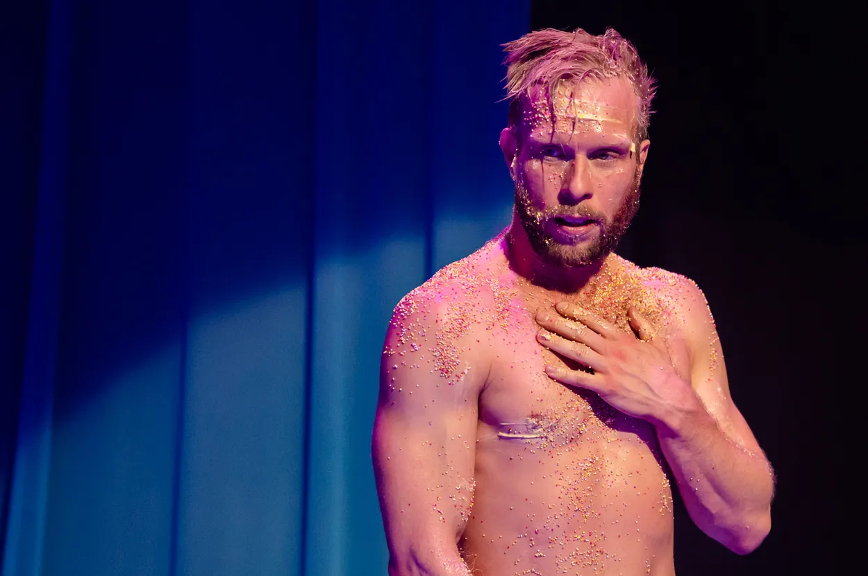
The placard features an idealized image of a natural landscape, with two groups of people: one of British settlers in structured suits, the other of Aboriginals in loin cloths. Thus, the image embodies the clash of civilizations that led to Bray’s mixed descent of both British and Wiradjuri origin. He explores this duality by dancing in accordance to contemporary dance in a colonial military uniform that flails around him like a tail in his turns, to a grounded deep knee bend stance in beige boxers, like a warrior dance. Having just instructed two gentlemen to dust him in powder, or as he calls it, “snow”, he shapes the powder as a face paint. He actively reclaims remnants of his lost Wiradjuri identity. He remembers his father reading from a dictionary, trying to pronounce words in his native tongue. Bray repeats the pattern, as well as sharing his disgruntlement of lost identity.
Bray grapples with the sensitive topic of him being too fair-skinned to be considered Wiradjuri, and utters he “is not responsible for the eugenics that wiped out his identity”. It is in the contrast of glitter and fluff with decolonization and demands for justice, he stands tallest as a performer in addressing highly contentious matters.
Woes of intimacy
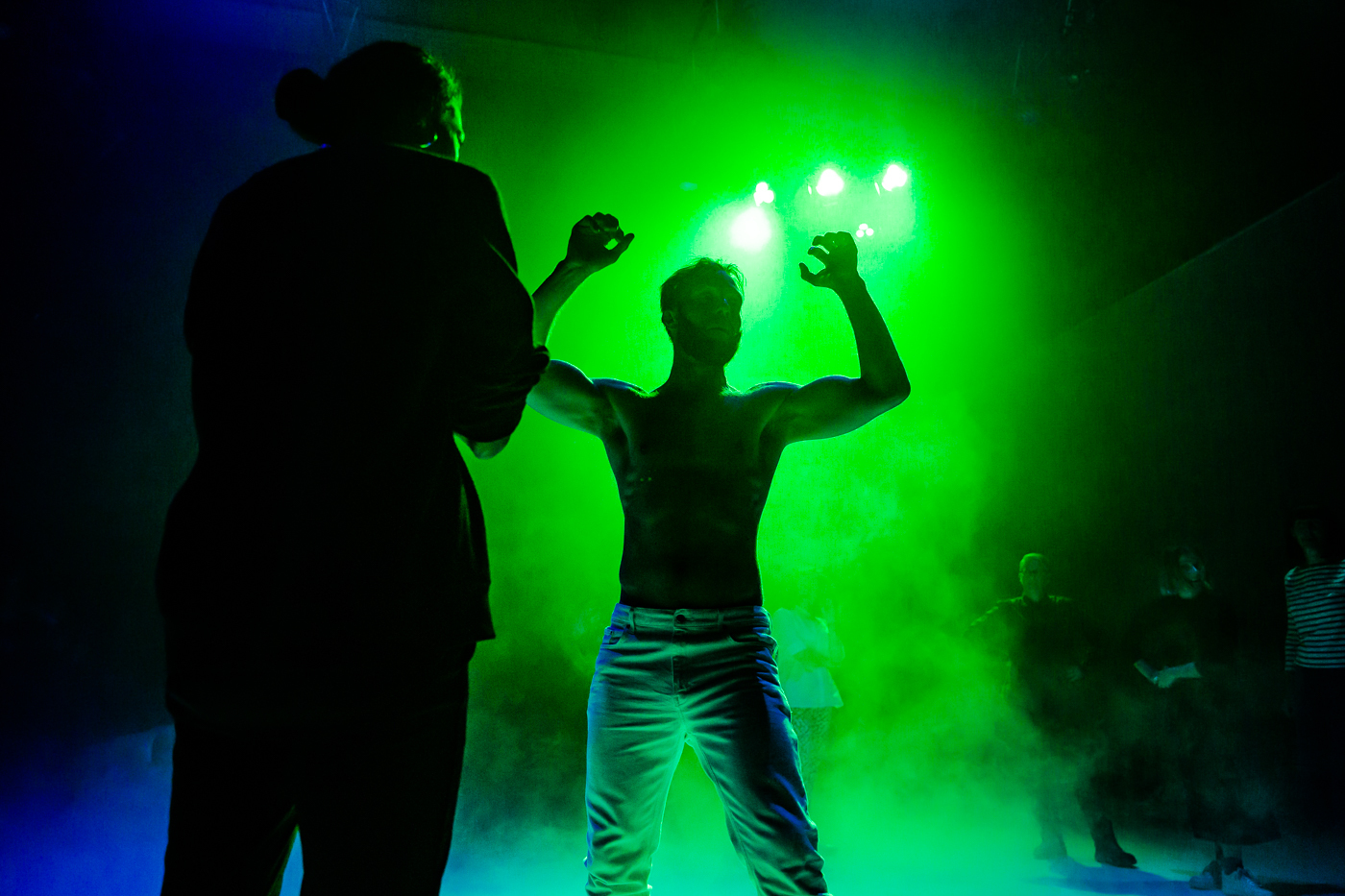
Dating becomes another arena of exploration for Bray, inviting us to a night rave and instructing us on how to move our hands or communicate whether we are “tops” or “bottoms” by bending over or gyrating our hips. It is a mastery of playful interaction, and becomes the backdrop for dealing with loneliness, fears and how genuine connection can be more difficult to achieve than simply “getting fucked” in a dating landscape dominated by and occasionally involving drugs. In one of the later scenes, he is creating a dating profile and is encouraged by a seemingly online voice, possibly AI, to act more “indigenous”. He is given a broom and encouraged by the deep digital voice in his performative identity. Bray later denies this position as stereotypified and opts out of the fetishization of his identity.
He smears margarine like body lotion and in his signature style of audience participation, encourages audience members to throw sweet sprinkles on him like the Australian treat of fairy bread. But the sweet treat does not end there: suddenly it is an array of whipped cream, chocolate syrup and marshmallows thrown into him on the aforementioned taffeta bed. The classical music culminates and the performance comes full circle in the overly sweet and daring approach of Bray.