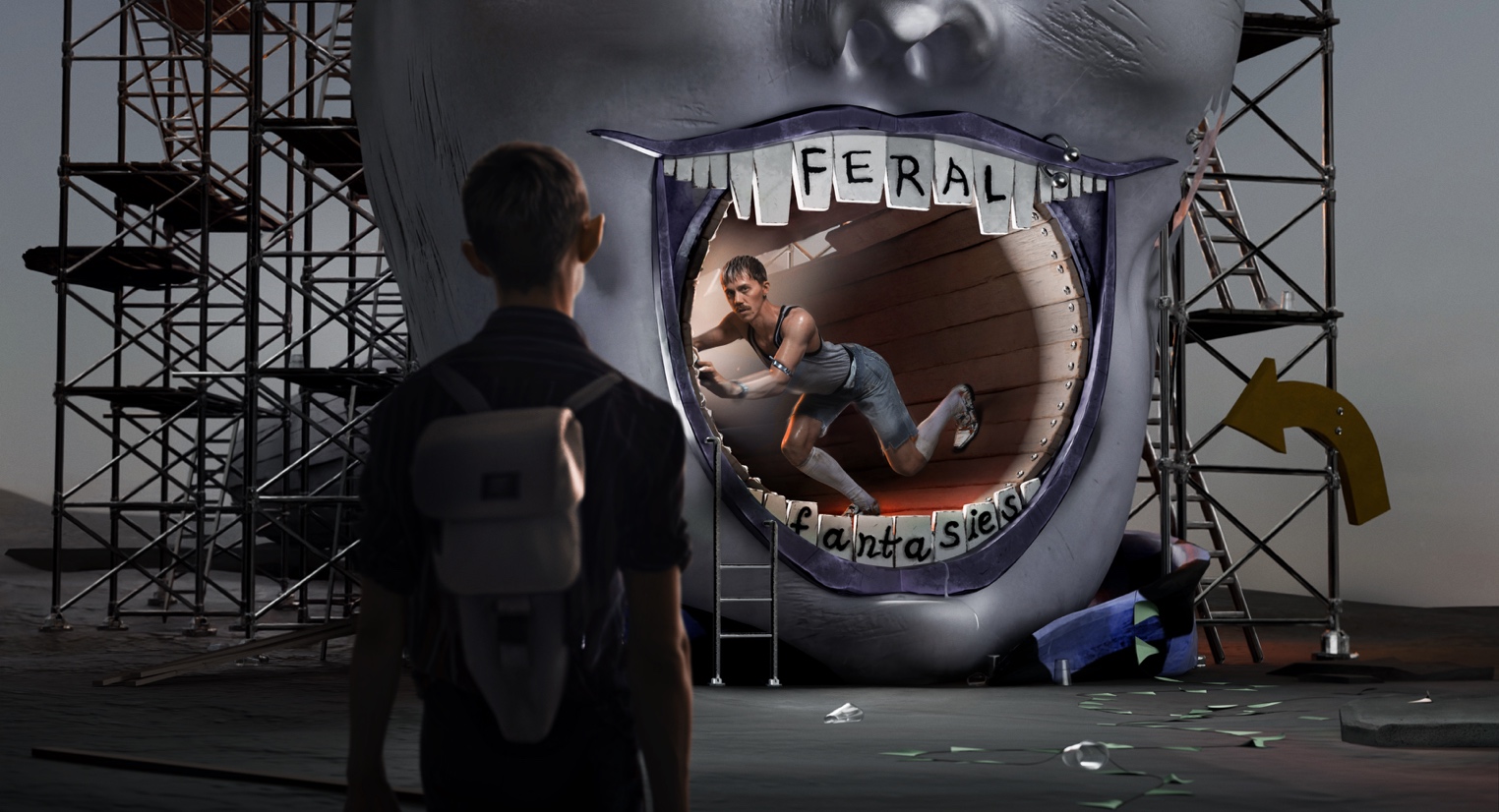
Swedish born dancer, performer and choreographer, Andreas Haglund, premiered a new work at Dansehallerne in Copenhagen in October 2025 entitled Feral Fantasies. The performance asks the question “Who´s a good boy?” and after seeing the piece, I was more than intrigued and curious as to speak to them about what has been the process of creating a work that questioned power play in more than one way.
Karin Hald [KH]: I want to start by asking you about the process of creating Feral Fantasies.
How did you come about locating this feral pet as a character, that performed in a liminal space between being domesticated and wild?
Andreas Haglund [AH]: There are several strands of thought, lived experience and artistic practice that made me arrive at this character. For a few years now, I’ve had a growing interest in the theoretical and embodied meeting points between queer theory and sustainability in the arts.
Queer theory is often regarded as articulations of social relationships between humans, of non-normative ways of structuring relationships, be they familial, romantic, gendered or otherwise.
Sustainability in the arts is often focused on the human relationship to nature and emissions: artists make work trying to re-enchant a toxic and ignored relation to the more-than-human, theatres reconstruct the way they use technology along measures of sustainability. These are all important efforts that I support, but I’m intrigued by another conception of sustainability: The one focused on the conceptions of nature within human relations.
‘Being against nature’ is an age-old trope levied against queer people for the way we perform gender, the ways we fuck, fall in love and build communities and families. But behind this hate-speech statement lies not only a socially conservative ideology, it also proposes a reductive understanding of ecology. These are two sides of the same coin. It is not a coincidence that many fascist parties are simultaneously trans/homophobic and want to drill, baby, drill. It is this very conception of nature as something pre-destined and god given, this Darwinian mythology of the survival of the hetero-patriarchal carnivores against the backdrop of the death of fragile insects, that rationalizes trans and homophobia.
But biological studies do not work that way, rather, Nature is the very composition of relationality: the mud, the swamp, the orgie of points of contact. It is the rhizomatic complexion of how species relate (fuck, fight, eat each other). This awareness of nature as something continuously becoming, in the process of always being enacted is something queer people understand by necessity and choice. We build our own networks of relation outside of hetero-patriarchal expectation and this throws us into constant dialogue with what it means to be human, with the ethics of our livelihoods and relations. We’re the symbiotic consciousness on the hetero-patriarchal processes of majoritarian society.
But how does all of that come to stage? Arrive in bodies? And what can dance as an artform do to embody these ideologies? I try to use the black box as an arena of socio-political discussion by way of the body and its complex processes. With a trust that the staging of aesthetics and dancing bodies contain these socio-political dialogues.
Zooming in from this bird’s eye view, let me return to Feral Fantasies. Having all these thoughts on the relations between human culture and natural processes, I started to become fascinated with human cultural expressions that try to imitate nature. Expressions that sit firmly in the body and have strong aesthetics tied to their practice.
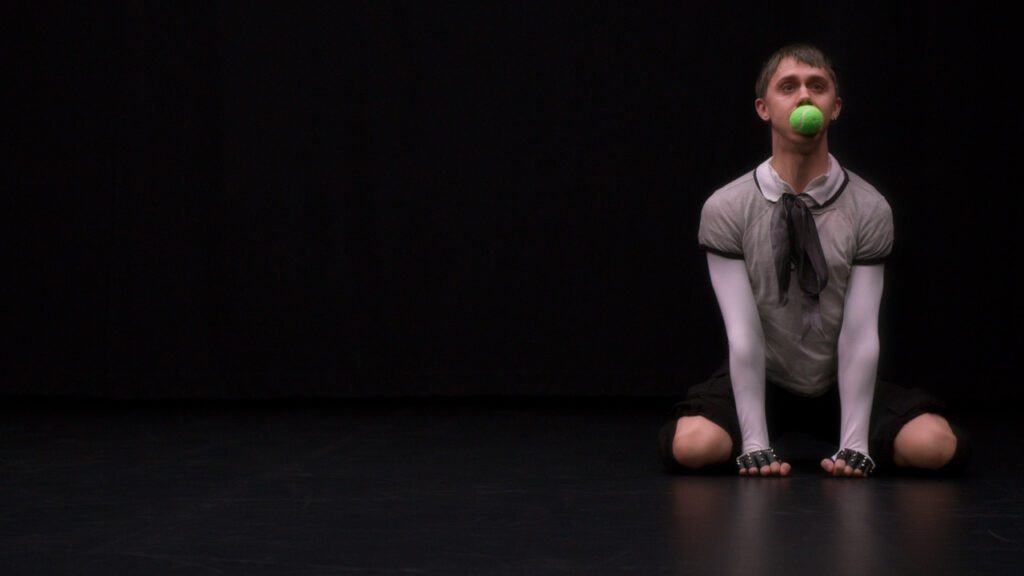
Specifically, the BDSM sub-genre Puppy play was a source of inspiration for the character of the piece. For those that do not know, Puppy play is a fetish where the participants dress up and act like dogs/pups (with specific rubber or leather or latex gear). There are often a pup and a handler, mirroring classic dom/sub relations in BDSM. While not practicing this subgenre myself, I found some of their methodology very intriguing for discussing power relations between humans, through a filter of an other-than-human performativity. In the black box, I saw the embodiment of this character caught between domestication and wildness to discuss the inherent double-bind of power present during performance. There is a link of determination between audience and spectator, the performer presents a material that in many ways can shape the dynamic of the room, yet it can never control how the conditioning of the audience views what is being presented. This fleeting play of perceptive power is what I found as a fertile playing ground for the piece.
KH: Thank you for elaborating your thinking around the piece. There are so many exciting strains of thinking that weave in and out of each other, that it makes me a bit dizzy with wonderment.
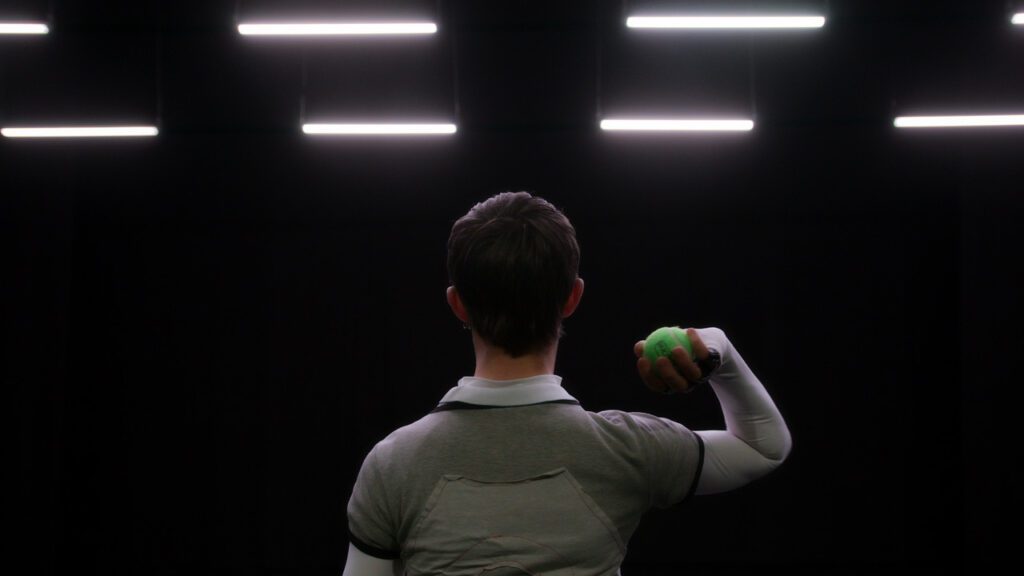
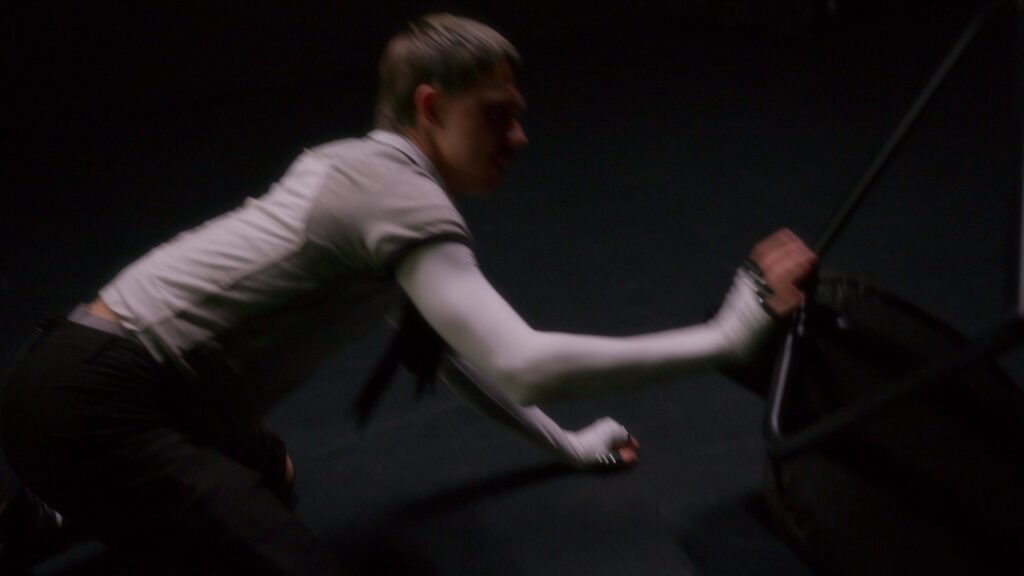
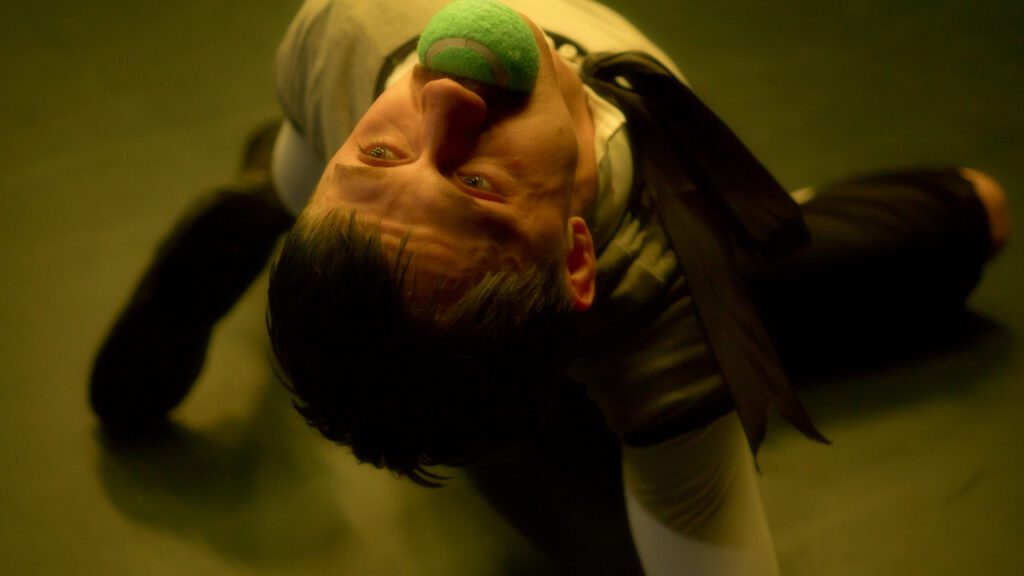
I want to jump to the ending of the performance, where you change from being the playful puppy, asking the audience to engage directly with you, by making them grab hold of your tennis ball and throwing it in (almost) endless repetition, instead of standing up and dancing to techno music. Here you seem to disappear into yourself, your own pleasure, instead of reaching out to us as to actively achieve it, although I know that there is also a real pleasure to knowing you are being watched.
What stood out for me in this change in the performance was the repetitive character of your movement. The movements, the dance you were doing, was made up of very small differences, and mirrored how one would often dance at a rave party – lost in beats instead of showing off.
How do you see these two parts of the performance relate?
AH: I understand the dizzy sense of wonderment, that is usually how I start my processes, wide and chasing. Then conceptualization passes through different layers of analysis (societal, aesthetic, historical, somatic) before ending up in a work. I tend to have very brainstormy and collagey ways of thinking.
Your questions make me think of a few interconnected moments from my process. Firstly, while researching pup play, their customs and practices, I learned about what’s called ‘the pup mind state’. It’s a state of mind where you ‘leave the human behind’ and embody a willful, obedient yet playful state of body-mind. It’s a practice of surrendering to the fiction of being a pet and surrendering to your dominator, or alpha in pup language. Online there are several resources and guided meditations that allow you to practice entering the pup state through tensing and relaxing different body parts, barking on command and listening to an ever more hypnotizing musical composition. Practicing this meditation in the studio felt eerily familiar to me. I experience an immediate comfort in allowing my body to take commands, but also without an explicit alpha setting the stage for the state of mind.
During a night out at a lesbian bar in Rio de Janeiro, I had a talk with Marga Alfeirão about the role of the artist. She insisted on wanting to be an artist that grounds her work in the cultural contexts that she lives in, rather than being an artist that makes every new piece ‘about’ a topic of research or interest. This brief conversation really stuck with me, and I had longer conversations about this with my dramaturge Lydia Östberg Diakité. I had an ambiguity about making a piece ‘about’ the pup play community, of which I’m not part. Yet so many of their practices resonated with my own interests, both in art and life. So, I started to think, where does this pup-state exist in my life? Is there anything I’m already doing, or that I’m already a part of, that resonates with this practice?
I came to the realization that the pup state was very similar to my experience of dance and dancing. Specifically long dancing sessions to electronic dance music, often taking place in clubs. These dance practices engage with a similar sense of surrender, to the drive of the music, the electricity of a dancing crowd and most of all to the logics of my own dancing bodies. These kinds of dances and the communities that make them possible are cultures I participate and live through. So, for me to bring them on stage felt like an organic con.
Besides that, there is also a similar negotiation with agency, power and control in the dances that come in the end. In the game of fetch that starts the piece there’s a clear relationship to power. I as the performer set the rules of the game, yet it is through the participation of the audience that the endless rotation of this throwing ball unfolds. Sometimes audience members actually practice the agency I invite them into by fucking with the rules of the game, holding on to the ball for too long or throwing it ‘the wrong way’.
To me, the dance serves as a mirror image of these power relations, but instead of between the audience and myself the primary negotiation is between myself and the dance. In my experience of longer and physically intense dancing, there is a point one reaches where thought melts into the body and where the sense of decision making is no longer cognitive, nor really intuitive. Like in the game of fetch, my impetus for movement is external to myself, it’s in the rhythm, in the room. In raving McKenzie Wark coins the term Xeno-euphoria, a sense of ecstasy by becoming alien to yourself, to your own body. This term resonates with this last dance in Feral Fantasies as there’s a double-bind of pain and pleasure in this mode of dancing, an ecstasy through surrendering, an exhaustion produced by continuously feeling everything and nothing through losing your body-mind into yourself and the world that surrounds it.
KH: I have been deep diving a bit into your other performances, choreographic works and the thoughts that surround them. You are clear about the fact that you pride yourself in performing in other artists’ work – to be of service to not only your own art, but also other queer practices.
I also notice a string of resemblances in what you have worked with yourself, in Surbending, a work you made together with FASCIA, where you are interested in surrendering in relation to subversion and survival for queer people.
It makes me think about how you navigate ‘ego’ (sorry for the Freud terminology) and perhaps a motion towards dissolving the ego. The way you position yourself in powerplay, both within yourself as well as when you encounter an audience, and how this relates to being queer, to letting go of an old-school idea of the self, yet this seems to be the path to becoming more yourself?
AH: Thank you for the question, I feel like it opens a relevant discussion on queer selfhood and how it is expressed in my artistic practice. Let’s entertain it for a minute.
As a queer person, meaning a person who disidentifies more with majoritarian societal norms than feels attraction to them, my sense of self is malleable, improvised and always in motion. Beloved queer theorist José Esteban Muñoz opens Cruising Utopia by stating that queerness is a horizon, an always not-here, a potential. A popular thought within queer theory that keeps me up at night. This statement displaces queerness, leaving it restless in continuous motion, uprooting it from ever finding solid ground. There’s a truth to this as queers often become masters of shapeshifting, of reading the social contexts around them and continuously having to mold and adapt around what is considered acceptable. This is a process that can contain both joy and violence. Think the joy of a drag king performer that embodies gender-fantasy vs the gay man who stays hetero-married in the closet his whole life but finds men to have sex within parks. Queer self-becoming is complicated and messy, pride cuddles up with shame, but the negotiation of where and how we can live in line with our desires, never ends. That negotiation is, in a sense, what it means to be queer.
In the case of surbending, Asta Norborg/FASCIA and I wanted to discuss a part of self-realization that many queers brush up against: encounters with healthcare institutions. Her as a trans woman undergoing monthlong psychological scrutiny and me as a receiver of PrEP, a daily pill that reduces the risk of contracting HIV with 99.9%. Although our medical process of inspection differs massively in scope, we both had to undergo a sort of ‘lifestyle inspection’ by a medical professional. Even though the sterile aesthetics of a nurse’s office gave my medical interview an ambience of professionalism, I found myself sitting against a complete stranger asking me the most intimate questions about my sexual habits. This institutionalized investigation of intimacy is a class example of how queers must adapt, improvise and perform identity in the face of the world around us.
In my artistic practice then, I rather emphasize another kind of self-becoming that living a queer life allows for. The attentive listening to your social contexts, to the cultural communities that surround you. I experience this listening as what you in your question describes as a ‘dissolution of the ego’ but simultaneously (and perhaps in contradiction with Muñoz) as coming home. Similar to what you say, as a path to becoming ‘more myself’. Let me paint an example that comes to mind:
During the pandemic I got obsessed with foraging wild herbs. As a newly graduated and unemployed dance worker, I needed something to fill the seemingly endless lockdowns with. So, I started to spend a lot of time among plants, specifically in Amager Fælled. Through endless days of looking at flora and not knowing their names I realized I had a sort of botanical analphabetism. With a desire to get my fingers dirty and my taste pallet stimulated I got swept away by learning the name, properties and potential human benefits of different species. From one year to another I was no longer walking in an indistinguishable mesh of green leaves, brown branches and gray bark, I was walking amongst Garlic mustard, St.Johns Worts and Itadori. A practice that is obviously not exclusive to queer people, but that felt similar to my experience of navigating identity. Similarly, as encountering and belonging to queer social context, this botanical-literacy project made me feel much less alone and I felt my sense of self expand into the beings and cycles of nature that constantly surround me.
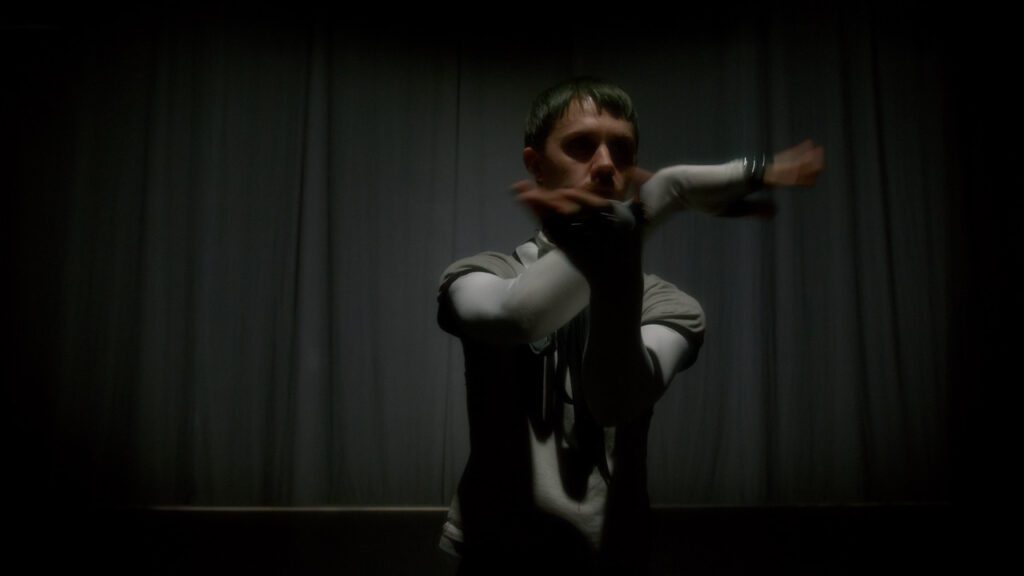
In Feral Fantasies I’ve come to realize I engage in a similar process with the audience. If I think of the perceptive material that makes up the reading of who I am, white, gay, masculine, abled bodied etc. as a botanical landscape of materials that are being read by an audience. How can I invite the audience into a dance around said perceptive materials? A tango that tosses and turns these preconceived notions around. Because without the shadow of a doubt these identity markers define how I move through the world, and what I get access to, yet I harbor a resistance to being tied down by them. I think all humans inhabit a complex psychology that these markers can never fully account for, they only give us direction of how to read. It is here I find that somatic practices that ‘dissolve the ego’ are a kind of solace, a comfort in the potential violence in the gaze of another.
I consider the piece as being a power bottom piece. Meaning, a work where I simultaneously surrender to being perceived as well as controlling this ‘penetration’ of the audience’s gaze to follow the pathway I’ve designed. In the case of Feral Fantasies this pathway is meant to not resolve any questions about who or what is being viewed but rather complicate the sense of the one performing. One could say that this process of negotiating how I’m being viewed works, as you rightly propose, towards a path of becoming ‘more’ myself. Because it is this social negotiation, the queer horizon, the attentive listening and immersion with the cultural contexts that surround me, that (some of) my sense of self lies.