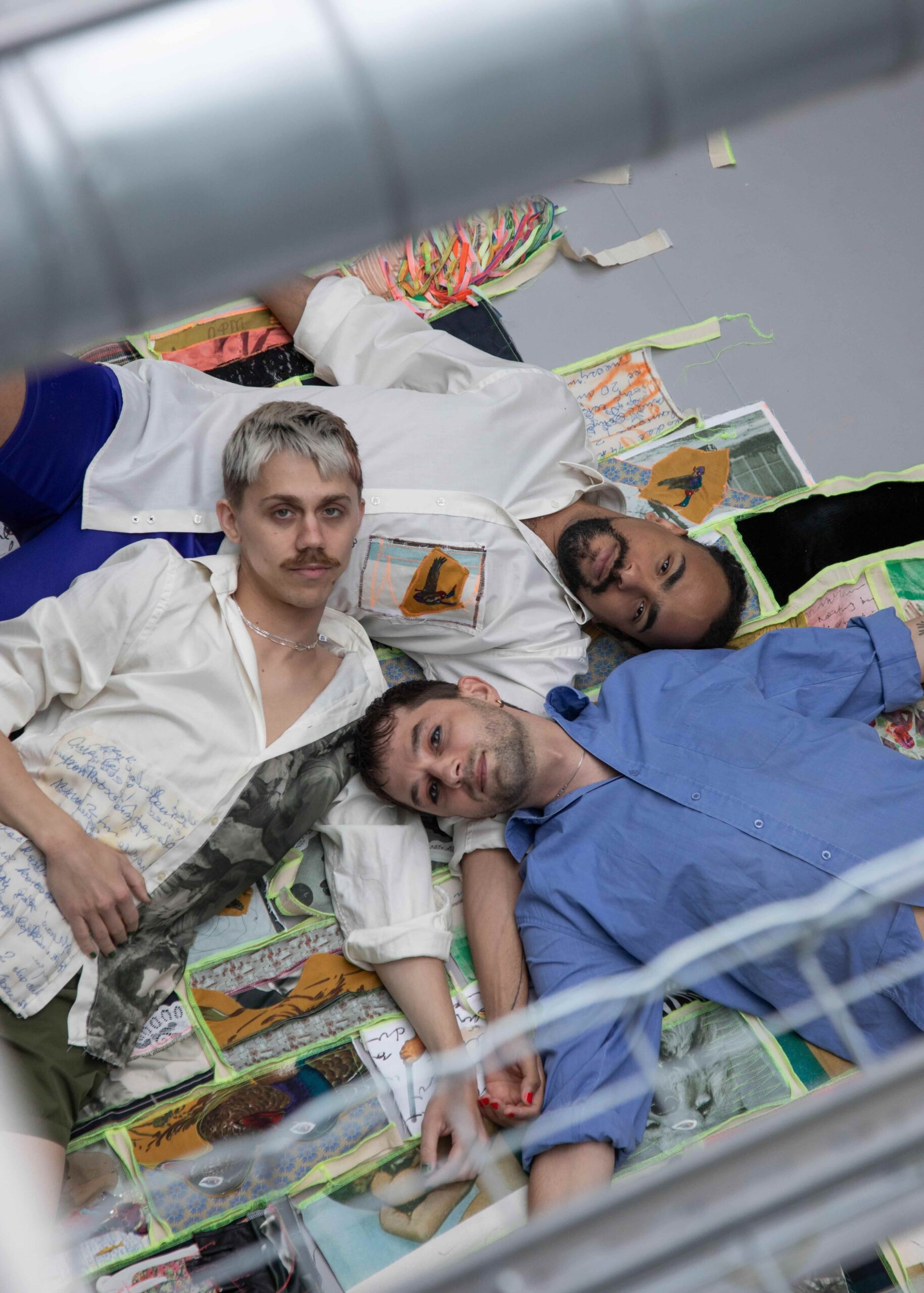
Imagine a space: a dance studio bathed in soft daylight beaming from windows above the ceiling. A small group of performers. A handful of visitors seated around the room, waiting for an embodied archive to unfold.
This is the opening of the wildly entangled archive of SZWEDZKA 8 – an old villa in Kraków, once home to female resistance fighters during the Second World War, and later to artist Vala T. Foltyn, before she fled in the wake of Poland’s anti-LGBT laws. This house, its memories and shadows, forms the painful core of her artistic research and this IN PROCESS residency at HAUT titled Tracing ashes while we are still alive – working on archives of queer histories and reminiscences of resistance, in the spring 2025, when this text was also written.
QUEER MARGINS
Vala Foltyn’s work orbits around this visual and performative archive of physical as well as spiritual heirlooms, reimagined through a queer lens. During her residency, she has reopened the archive and created a new choreographic installation. Words, movement, and textiles generate shifting flows of imagery—a literally speaking living tapestry of images, dance, and reading.
Time and time again, Vala has returned to this extraordinary archive of personal grief as well as language and counter-language. In performances that invoke magic and rituals, she is rewriting history from the margins—through old cookbooks, family photographs, fragments of poetry, oral history, folk iconography, stories of migration, queerness, and witchcraft. In 2024, she even published a book on this archive, Szwedzka 8.
Completely in sync with the process-oriented settings in HAUT’s residencies, Vala’s art seems to be in constant evolution—each iteration unfolding new choreographies, images, and gestures from the archive.
Here, I want to focus on what cannot be read elsewhere, as I attempt to recall the emotional landscape of movement—bodies animating dissolved communities, fragments longing to be touched, to be seen, as they search for each other, reach out, and lift one another in and out of dreams—a serious gentleness, as we were visited by a caring, yet demanding, ghost from Kraków in the dance studio this rainy Sunday at Thoravej.
SEAMSTRESSES
A few days earlier, I visited Vala and her collaborators—the artists Sandy Harry Ceesay, Andreas Haglund, and Katarina Zalar—as they were assembling a quilt of fragments from Vala’s archive. An archive she once managed alone in exile, but which is now shared and activated in close collaboration with a new group of artists. Vala is literally adding threads from Poland to the quilt, opening up, queering the archive.
In the old villa, she found textiles left behind by the former residents. And this art of textiles does not only relate to the history of the house—it’s, in fact, all of Poland’s history that is brought to life, as Vala gestures toward the country’s past of massive textile production during the Soviet era.
At my first visit, the dance studio was transformed into a sewing room. As the artists, or seamstresses, work by the sewing machine, I keep returning to the small bricks of images printed on fabric. Around me, I notice someone painting, someone rehearsing a choreography, and a microphone placed inside a fur hat, laces and threads, handwritten notes, images of ducks and others of dogs—even one of dogs playing ball.
They are the dogs of the family who once lived there. They are our familiars, Vala says—creatures, companions, and sometimes even assistants of suspected witches.
CAKE KNIFE
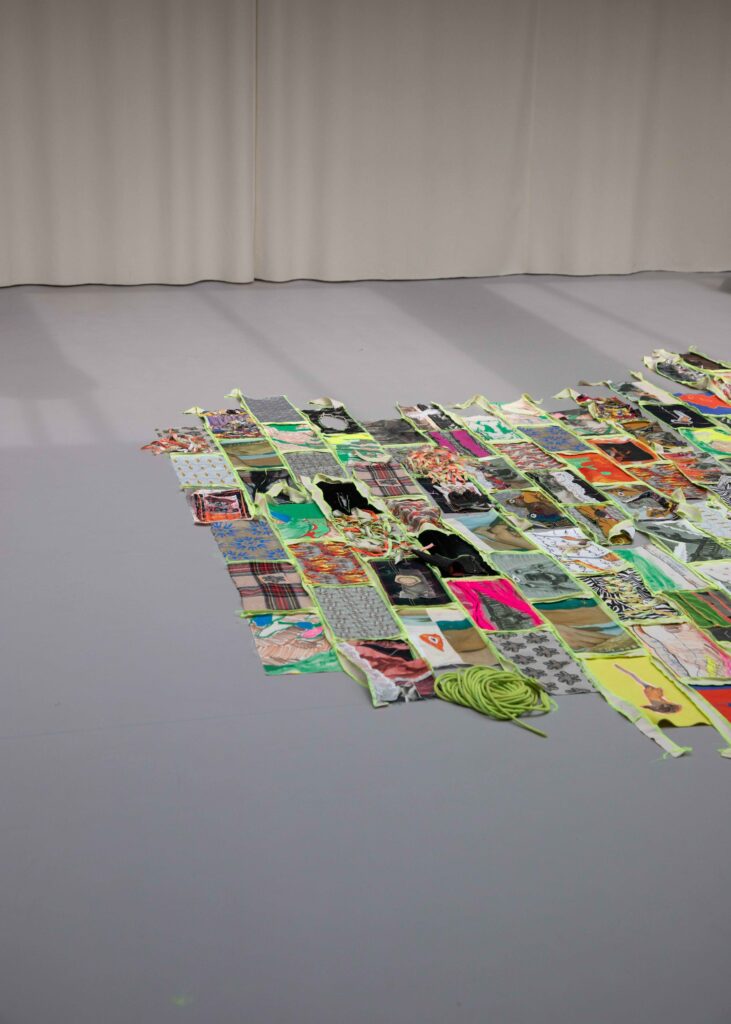
I try not to interfere, sitting in the middle of the studio, as the quilt slowly reveals itself as a score for the performance I have yet to experience. I’m mesmerized by the quilt. Its repeated visual fragments: photographs, contemporary and historical, iconography, nakedness, erotic lesbian drawings, coffee-stained folklore. A drawing of a hand with a cake knife from an old Polish cookbook, Kuchnia Polska, found in the house. Now placed in a new setting, reproducing old fragments in a queer context.
This hand, cutting through cake and meat—
a knife cuts into meat. Sticks into flesh.
Stitches in fabrics. Threads.
Covered by unreadable handwriting. This word reversed: love. Mirrorwritten magic.
ICONOGRAPHY, PORNOGRAPHY
Some of the bricks in the quilt are covered with displaced, doubled images from the archive—photos and patterns—symmetry as for a luxurious silk scarf. But this constant mirroring happens not only in a huge network of repeated images—it occurs within the individual pieces of fabric themselves.
Small pictures are reproduced in new visual constellations—even in the costumes soon to be worn by the performers.
In one brick, the face of a holy icon is repeated in the shape of a symmetric flower. An angel in a collage stands out, exposed and bare-breasted.
Iconography, pornography.
Naked breasts, and holy.
A Catholic icon wrapped in fire. Burned at the stake. Witches, martyrs.
I notice a spine in an X-ray—and a pelvis, Vala adds.
A ghostlike bodily presence printed on transparent organza.
Everywhere, threads.
Loose stitches.
And fire.
Danger behind every stitch.
ENTER
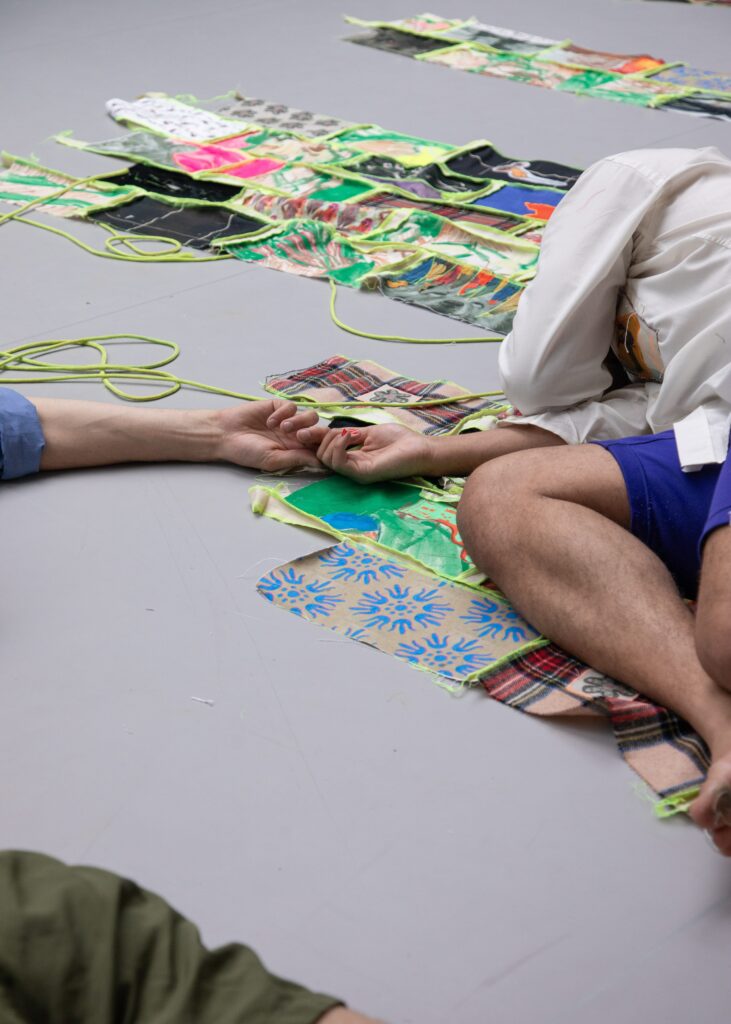
Imagine the dance studio, peaceful, no harsh sunlight, gentle, gray daylight. Audience seated. The performers are almost resting as Vala drums carefully. Vala, Sandy and Andreas are dressed in costumes by Katarina. Costumes decorated by images I recognise from the quilting a few days ago. Embroidered threads on their shirts, patches from the quilt, now placed on the floor between us.
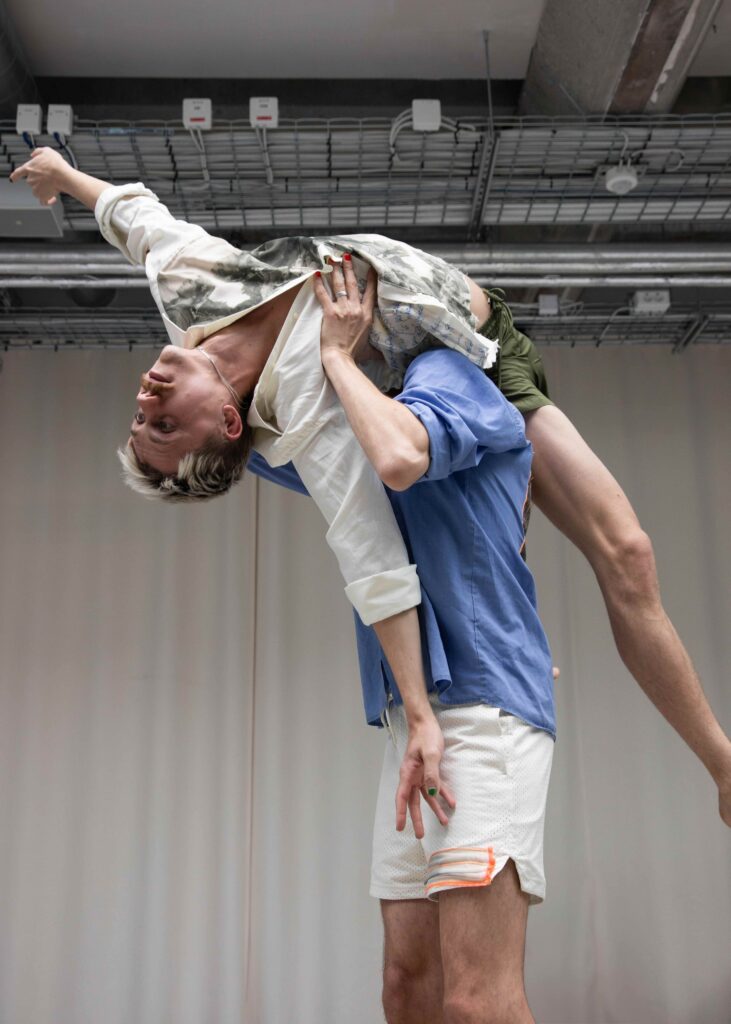
Vala, Andreas and Sandy take turns. Take turns stretching and reading aloud from books, including the old cookbook and Vala’s book Szwedzka 8: the scents of queer resistance: notes on witchcraft and queer magick, before they move towards the quilt, their feet and hands touching the fabric as they’re driven by something, sliding in, out, around each other. These gentle touches.
REACH, READ
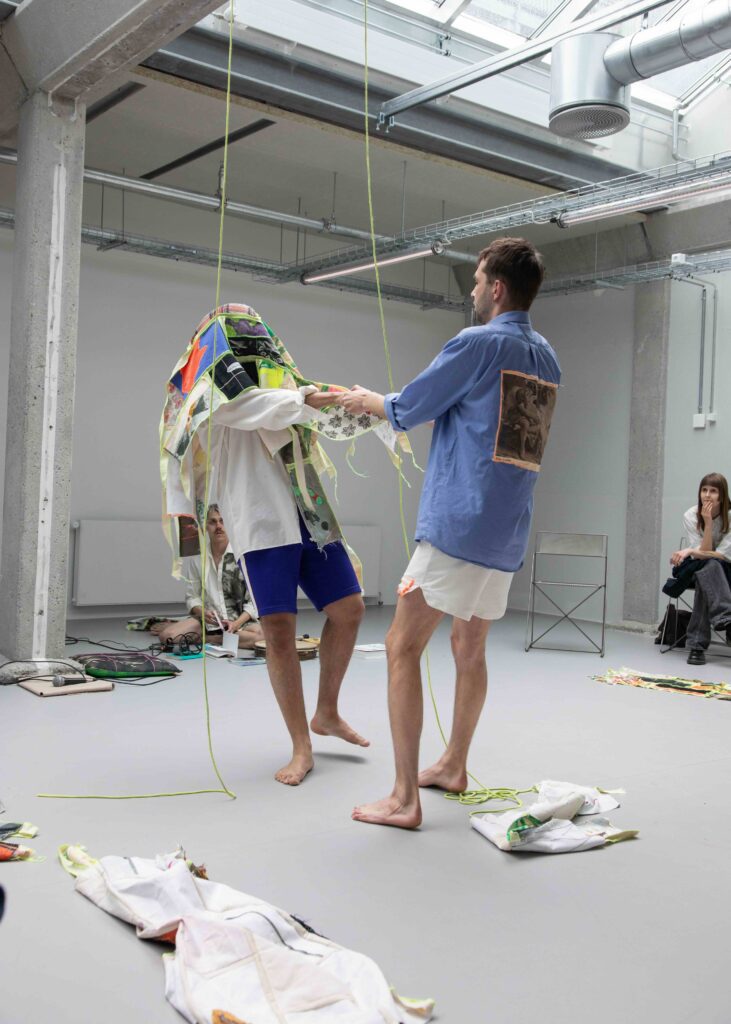
Dancing, solo and in duets, they tear the quilt apart. Fragmented again into smaller pieces. One piece is ritually fluttered above one of their heads—almost violently, or with sudden eagerness. Then, with equally serious tenderness, Andreas is gently wrapped in the fabric and rocked. Back and forth. Reaching for each other. —Are you asleep? A voice whispers in my mind.
Vala folds another piece of fabric around her head, like a headscarf. She is drumming, while the others pull each other along a strip of cloth.
Back. Forth.
In their reading, I catch a few words: marked, trauma, restore justice, among other words in Polish from the book Flesh (2019) by Aneta Żukowska, a chapter named ‘Pleasures/Unpleasures’. Cheesecake, sleeping naked, listening, kissing, horse riding. Then: too long nails, unwanted touch, mosquitoes, violence.
The drumbeats evoke a force—shouts, ritualistic, rhythmic dance in circles, reminding me of the Adonia festivals from Sappho’s time.
HOW LONG
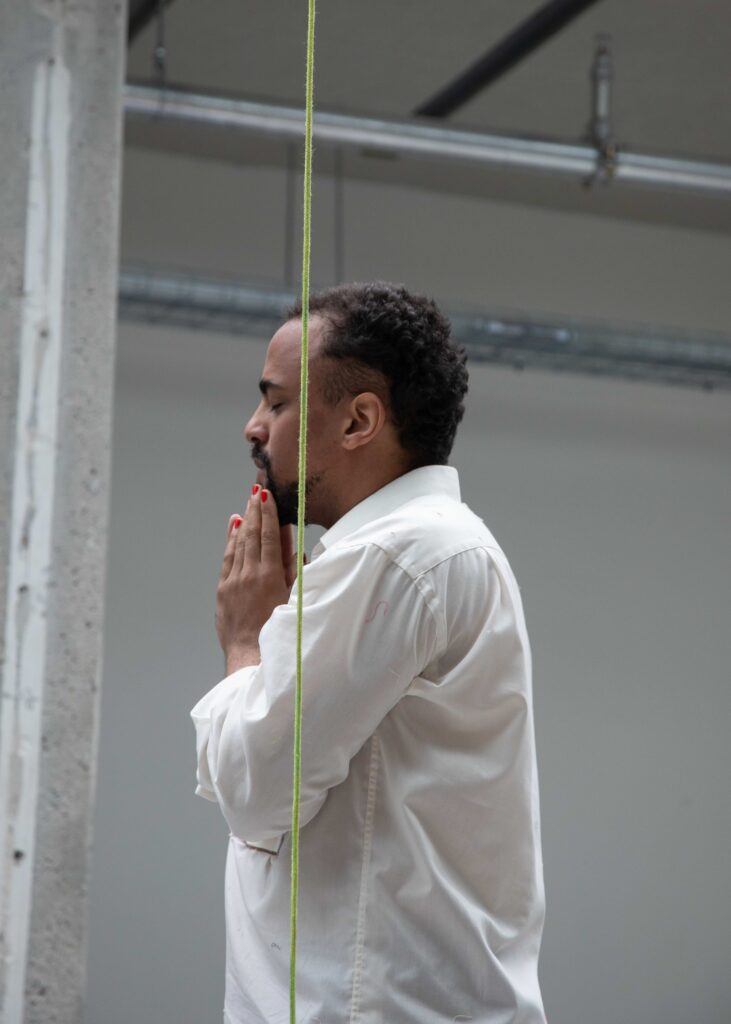
A space so intimate, so close, and still, as audience, our own space to perceive: a hand caressing a fabric, all the time, catching something, cuddling.
This material, constantly in process, now awakened by four artists and a community of ghosts, is so contradictory.
Chaotic, yet elegantly organised.
The simplicity of care, the beauty of colours everywhere, yet the ugliness of the world.
Still, something heavy, and I recall Vala’s words: How long one can live in constant survival mode.
As spoken not only by her, but by every spirit of the villa, through all times, history, and archives, this heaviness is real.
And before I reach the end of this text, a conservative government is elected in Poland, again.
In the dance studio, this has not yet happened.
And this space of immediate, emotional healing still exists.