This year, Den Danske Scenekunstskole’s MFA in Choreography graduation performance featured the students’ graduation pieces at Dansehallerne during the first two weeks of May. I am writing the peer review of the graduation show as a continuation of my experience with the same students’ first-year work on March 6-9, 2025. The review order of the five shows follows the performance schedule. What I call a ‘peer review’ is written from the perspective of a peer sitting next to the artists, with the attitude of thinking together as a continuation of co-artmaking, extending the artistic questions and connecting the artworks and the audience experience. The five graduation shows experimented with different performance-making styles and methodologies, deepening each choreographer’s artistic inquiry and aesthetic.
After all
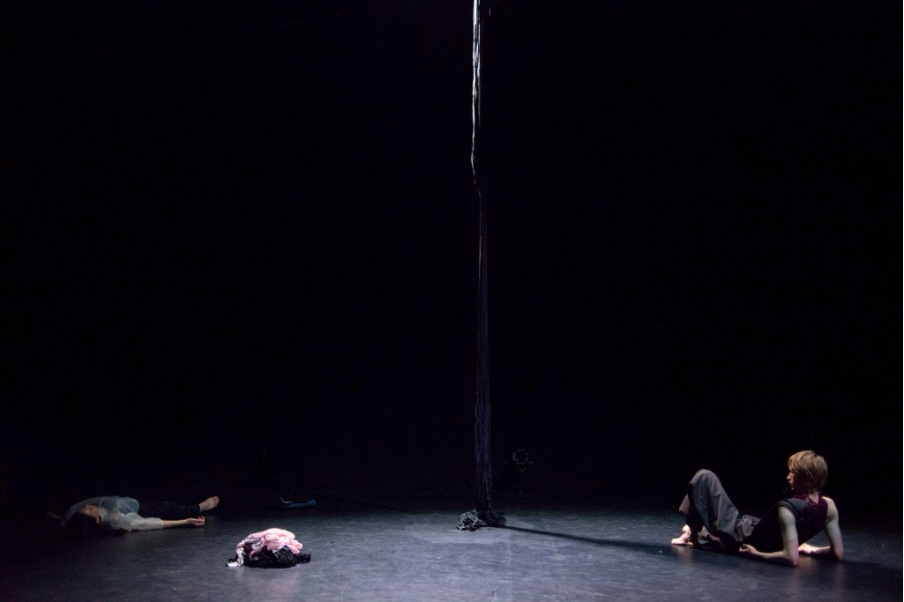
Warm, deemed light, with cello music flew out from the black box. In the space, curtains hang from the ceiling, dragging down to the floor. Three performers were performing their own dance movements or actions, deeply concentrated in their own states. One dancer was performing abstract movement in dynamic interplay with time and space; another dancer was touching their body parts closely to the floor, dragging them; and the third dancer was taking the curtains down, repeating the gestures of pulling. I saw a clear distinction between performing mundane actions and dance movements. Since postmodern dance includes a range of gestures and actions, there is no clear line between dance movement and performing gestures. However, in this case, the gestures being performed had a clear function – pulling the curtain down or opening the door – which looked distinctive from other movements without clear functions. The three different movement textures occurred separately and sometimes synced through awareness of one another in the space. Each performer’s repetitive or cyclic movement seems to come from their own movement qualities. Still, there was no more intended hint to read. Instead, as written in the description, it was an assemblage of “volumes, energies, and the presence” of dancers and the curtains in the space. Based on my understanding of the choreographer (Carla Anacker)’s first year school performance, minimal, score-based, durational, and phenomenological, I anticipated that this assemblage invites the audience to experience openly what arises from the unsettled process. Unexpectedly, over time, a theatrical moment emerged from this assemblage as one performer’s functional movement became more human, while the two dancers became more abstract, caught in tension between the two aesthetics.
I’m questioning this tension and think it may be because this work is trying to respect each performer’s own presence and character, rather than fitting them into a single score and movement style or a single choreographer’s coherent aesthetic. In this regard, I hope to further explore where this respectful choreographic practice of letting various presences, aesthetics, and styles coexist brings us to a new potentiality of choreography that hasn’t been here, and the fermentation of this practice of caring and attentive relationship in artmaking.
Aircon
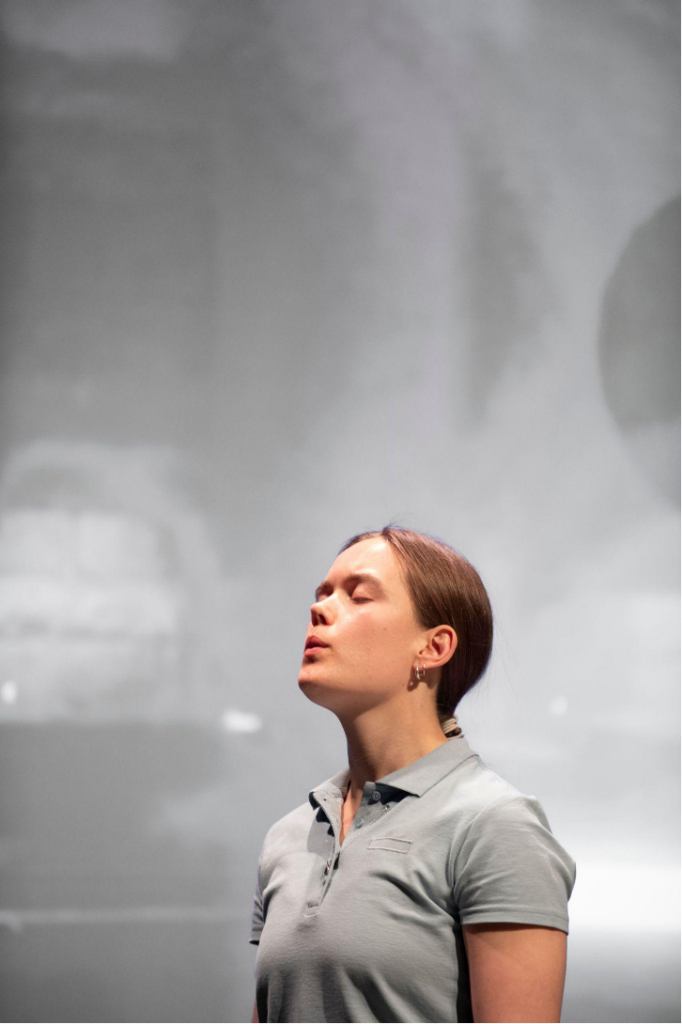
Right after the audience takes their seats in the black box, a video turns on, and the sound of a ventilation fan fills the space. A performer enters wearing a neat, uniform‑like outfit. She executes everyday gestures with extreme precision: taking off her hat and placing it on a chair. Her meticulous actions as an employee hired to maintain this space turn the stage into a colourless, odourless environment where not a single speck of dust or misalignment seems allowed. An artificial, dry, post‑nature space — a space where the traditional meaning of ‘nature’ has vanished — and therefore perhaps a dystopian future.
The employee looks up at the ceiling, making vocalizations that spread through the space as if checking the airflow in the room’s nine zones. She returns to one zone where the sound had stopped, gathers the air as if to catch it, places it in a plastic bag, and exits. Simultaneously, a narration voice begins. It explains that, at the governmental level, an investigation was conducted: air is related not only to the survival of human bodies but also to the persistence of non-human bodies, such as concrete buildings. Research experiments on air maintenance were conducted, but when funding was cut, the research group dissolved. Since then, one air‑handler has been assigned to each building to maintain its air.
This witty satire on concrete architecture and the precarity of temporary labour makes the performer’s earlier actions legible, and the audience bursts into laughter. When the performer reappears, every strange gesture she makes now reads as an act of handling invisible air and as a signifier of her character. On top of the performer, the video of diagrams marking air circulation in building blueprints, footage of air ducts, the sound of ventilation, and music assemble into a composition that plays with the audience’s perception and cognition of what is happening here. For example, a new element like a short video appears and flashes briefly, like a premonition, waking the audience with a surprise, and then disappears. The same element returns in medium duration, repeats, and, once fully recognized, appears in a long sequence that guides the audience into immersion. The timing and placement of each element suggest that the choreographer (Lara Vejrup Ostan) and her work carefully measured the audience’s perceptual register in real time.
When the ventilation propeller is juxtaposed with the performer’s repetitive turning and circling movement, an overwhelming light suddenly pierces through the space and the audience’s faces. As if to remind us that before concrete consumed the whole space around us, there were once green leaves and bright light. The dazzling light saturated the stage and then vanished. The space returned to its colourless neutrality. The ventilation sound resumed, futile and indifferent.
Didn’t someone say that as global corporations like Nestlé began selling water, one day they would sell air? This performance recalled for us a dystopian future where the air required for life is in crisis, with its weird human character, and delivered perceptual pleasure through micro‑compositions and precise timing, densely prospecting the audience’s cognition and experience.
Caduta
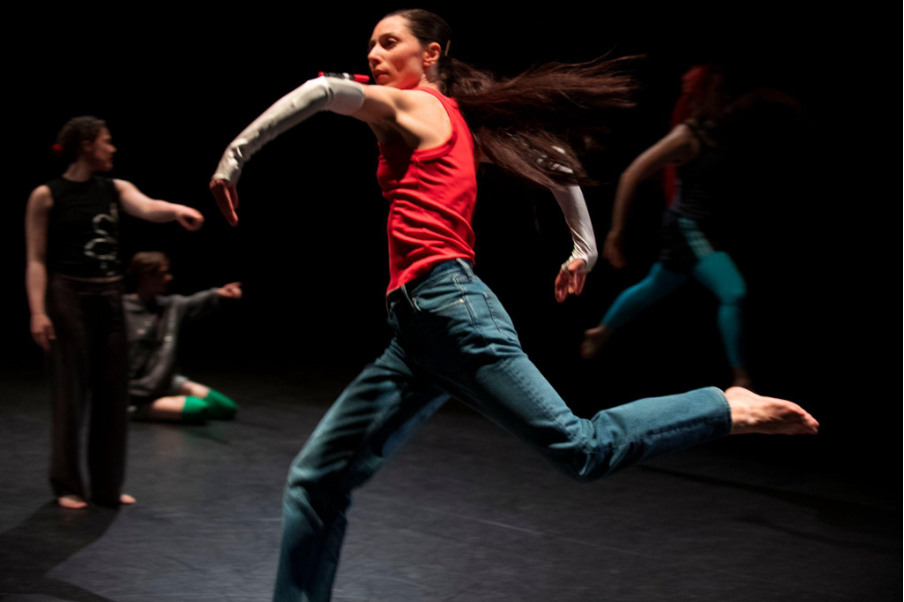
Four female dancers stood in the corner of the stage, facing the audience as they entered. Each performer had a distinct individuality, yet they shared certain props, such as long hairpieces, floral decorations, and vivid‑coloured tights, which created a sense of group identity. Two dancers, as a pair, began to move like a social dance, evolving into partnering and weight-shifting contact. Later, another pair repeated a synchronized movement phrase with a quick crossing of the feet, like a ballet pas de bourrée, and small jumps left visual traces in my eyes.
The relational configuration continuously shifted among four performers: once as a duet while the other was solo, then as two duets, and back to the original. Between movements, dancers exchanged small notes or wrote one with a pen, which was read as a gesture of intimacy within the group. Even when dancers performed the same movement phrase, there were differences. As the movement was repeated, the pattern of movement spread within the group. Earlier movement re‑patterned and returned with repetition, gradation, and amplification. Eventually, all four jump together, filling the space with heated energy. The choreography by Ottavia Catenacci gradually built the group dynamic, not through synchronization of sharply cut lines but through natural, flexible contours, forming a kind of swarm.
What choreographers have not wrestled with the question: How do we escape the uniform, disciplined nature of modernist group dance? Beyond the modern dance’s formalism and the Cold War’s mass game, choreographers have sought group dances that are not ‘group dances’ — movements that sync without being artificially matched. Like birds in flight, fireflies switching on and off in time, or tiny crabs on tidal flats that remain still and then move simultaneously. In this work, I felt the joy of each dancer existing in their own individuality while simultaneously harmonizing, and of the entire group moving together with a certain excitement and motivation. I was reminded once again that the performing arts, in which choreographers and dancers design this artmaking process together, are truly a micro-experiment of creating a social community with a new ethic and vision.
Even without an explicit narrative, the dancers’ gestures — exchanging notes, meeting each other’s eyes — and the cultural symbolism of costumes — flowers, long hairpieces, and tight — evoked textures of femininity and unnarrated stories. I felt like watching a coming-of-age film of sisterhood, friendhood, and womanhood. The dancers’ diverse presences and movements also gave rise to a wide range of femininities alongside the performers’ intertwined relationships. Regarding the title Caduta: according to the Cambridge Dictionary (Italian → English), it means ‘downfall’, a disastrous fall, a final failure or ruin, or the act of falling. To fall, one must first leap. The dancers leap together in order to fall. They drew strength from one another, leaping with the assurance that falling is okay. The trust and affection spread to the audience, and a sense of shared breath, fullness, and warmth filled the whole performance space.
Looming
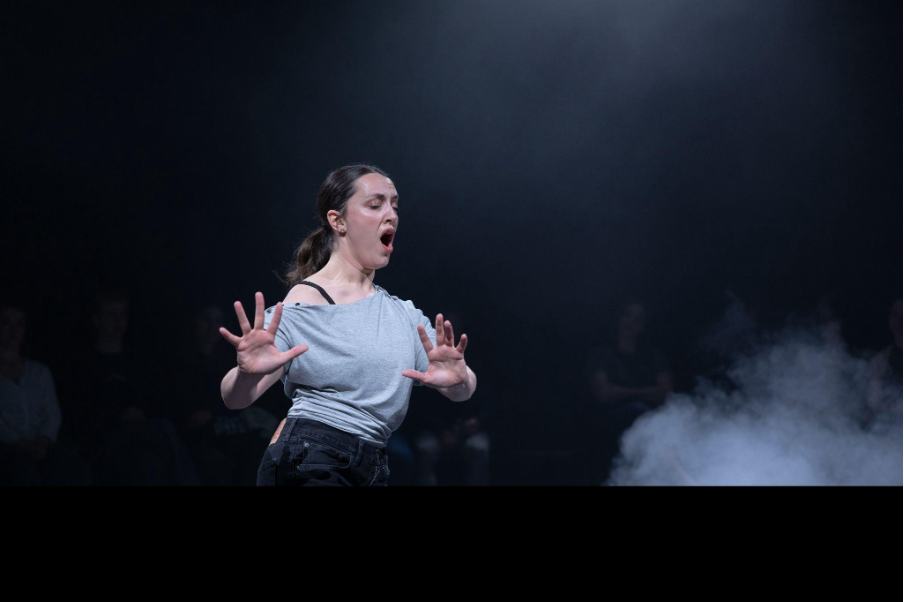
In dim lighting, with heartbeat-like music, a performer entered wearing a black dress with leather on the torso and Mary Jane shoes and began to tell a story. With a presence that commands intense focus — seductive, desiring — she tells the audience, “I am here with you.” Then the lighting shifts to bright house lights, and she comes close to one audience member, whispers in her ear, and asks for a request. A clear aesthetic rupture occurred: from theatrical seduction, acting out a certain quality of femininity, to a direct relational encounter with the audience, inviting an unpredictable reaction. This work continuously blended the two performances’ aesthetics, fast-paced like film editing.
Later, she crawled sensually, animalistically, toward the audience. As an audience member, I felt torn about whether to watch, accept, or avoid this surplus seduction. When the lights suddenly brightened again, the audience felt a flash of shame, as if our internal conflict had been exposed. This psychological play with the audience seemed a continuation of the choreographer, Thjerza Balaj’s earlier artistic inquiry. In her first year of work, the audience was confronted with performers’ seduction, and later, the faces of the entire audience were projected onto the big screen, an indirect test of audience psychology. This time, the relationship between the performer and audience became more direct. The seating is arranged in a circle, making the audience look at each other’s faces and heightening tension as they anticipate being exposed. Later again, after she changed into jeans and a T‑shirt, she counted numbers like “25, 30, 35,” ventriloquizing the voice of music. It felt as if the audience was being counted, an act that dissolved anonymity and exposed.
She silently handed a cup to one audience member, then danced a techno club‑dance‑like sequence, but in slow motion or with an off-beat rhythm. In that way, the signifier of club dance twisted. And the layers of comic, seductive, uncanny dance and surplus feminine clichés created an effect of estrangement. The cutting and weaving of theatre representation and happenings, femme‑fatale femininity and surplus seduction, all rhythmically edited, created an immersive experience driven by the performer’s strong presence and performativity.
Orion, I’ve Died So Little
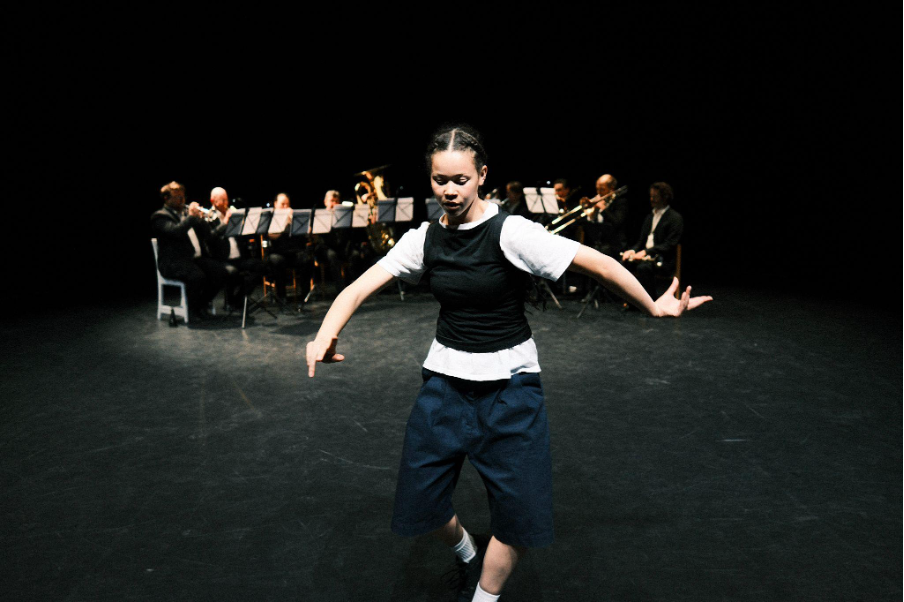
Nine chairs of different shapes and colours were placed on stage. A dancer entered through a door visibly. In dim lighting and stillness, she started to dance movements, non‑narrative, abstract, with glimpses of modern ballet or modern formalism style of dance. She paused occasionally to gaze at the audience, as if speaking through movement. For example, she held her arms in front with rounded elbows, forming an oval, as if showing her palms to the audience. These kinds of gestures created a relation between the performer and the audience, interestingly, through abstract dance. This part echoes the choreographer, Inaja Katharina Skands’s previous work, questioning the possibility of relation, emotion, and affection passing through from non-narrative dance.
Rolando Vázquez Melken (2020) ‘s Decolonial Aesthesis argues that modern and contemporary abstraction arises from rationality as a “distanceless distance,” affirming form as presence, often removing other worlds of sensing. This critique, pointed at Western abstract fine arts, also applies to Western dance history — modern dance’s formalization and postmodern dance’s removal of story and emotion. Abstraction can sometimes prioritize rationality over emotion and ‘affect’. In contrast, this work uses abstract dance to reach the audience, embracing its beauty while overturning its relational limitations.
Suddenly, a brass band enters, breaking the quiet atmosphere, and sits on the nine chairs to perform live music. The dancer begins to dance to the brass music — not exactly matching the melody, yet resonating with it. Seeing her dance, vibrating with the sound, took me to a traditional, beautiful image of dance set to music. She no longer looks at the audience, yet the audience remembers how natural and resonant it is to watch a dance to music. Dancing to music has become a subject of caution within postmodern and conceptual dance discourse, which critiques representation and passive spectatorship in Capitalism’s immersive apparatus. In this rational, critical discourse, dancing to music became taboo or considered naïve. Yet storytelling and dancing to music are fundamental human expressions. This work seems to re‑enchant what those discourses once erased.
Another happening emerges: a man at the end of the brass band does not play his instrument. He slumps, as if drunk, sliding slowly toward the floor. At this point, it becomes clear that the work experiments with how the character of abstract dance shifts across different settings. In this third setting, abstract dance, brass music, and comedy form an odd constellation. Music emotionalizes the obscure seriousness of abstract dance, while comedy satirizes that seriousness.
In the fourth setting, another performer enters through the door, walking along the wall with a mysterious aura, leading into a trio. A typical group dance unfolds — same movement, same timing — highlighting unity and humour. The final scene intertwines performers from different generations and dance styles, with a freedom beyond the disciplined perfection once demanded by modern dance. During the transition to the blackout that marked the end of the performance, one of the instrumentalists accidentally turned off a lamp slightly late. It released a small ripple of laughter in the audience, once again affirming the closeness and looseness that performers and audience felt through non-narrative dance to music.