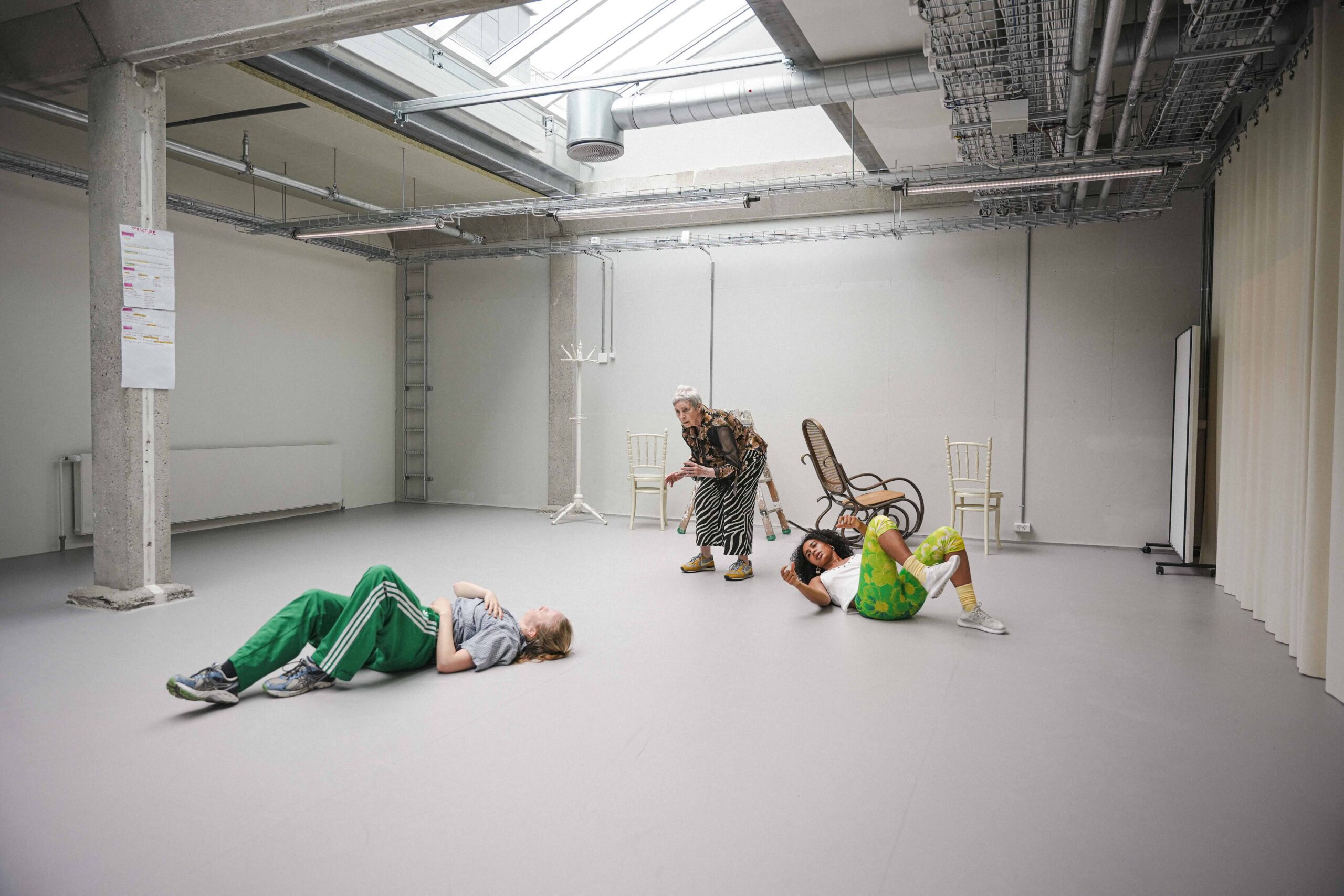
During a two-week IN SEED-residency at HAUT in 2025, Alvilda Striim, Sissel Johanna Bakken, Elisha Mercelina and Thorunn Gudmundsdottir have investigated the distracted body and “distraction as a different type of attention and thereby fostering a critical alternative to capitalist notions of focus and productivity” in the words of the artists.
As a writer I am invited into different stages of the process. Welcoming the process into the text I have decided to share embodied experiences, notes and glimpses from three different stages that I have decided to call The Copy Body, Worksharing and Audience Conversation.
I welcome you into a text of wondering and reflections, notes and quotes.
The Copy Body
The first time that I meet the group of artists I enter their workspace during the second week of the residency. Stepping into the studio at Thoravej 29, I am immediately met by warmth in several ways. A heartwarming welcome from the four women combined with the heat from the sun entering the glass roofed room creating a feeling of being in a very warm aquarium.
During the session I am invited to join an exercise. I do not doubt whether to dive into the exercise in collaboration with the group who have created a very safe environment. With my own background in dance, I find it natural to dive head first into a movement exercise. The writer in me also thinks about the opportunity to create a part of the text deriving from a more embodied practice, something I am already investigating in other parts of my practice and something I am very curious about.
Alvilda Striim facilitates the exercise telling us that it is the classical copy body game turned into a movement exercise where we will try to re-tell the ‘body story’ through seeing and listening to each other. If you do not know the copy body game, I can shortly tell you that it is about passing and replaying, an instant retracing with full commitment and accurate guessing, memorizing the seeing and the listening. which is almost impossible and the ‘body story’ ends being destructed when the last person in the circle has to pass it on. I am excited to see how we can copy the game into our bodies.
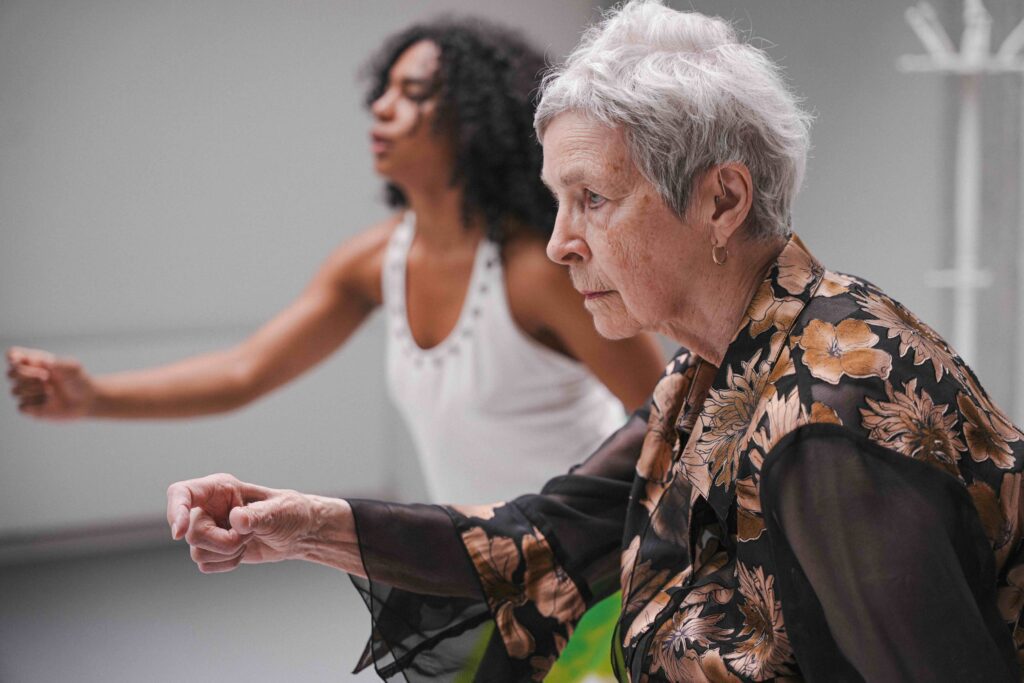
We stand with our backs to the wall. Sissel Johanna Bakken starts creating a small phrase with her body, the rest of us carefully observing how it looks. I notice myself trying to feel in my body how it would be to actually do the movements. As I enter the floor as the last person in the row this is how it goes.
“Jump, jump, swinging the arms, I feel the satisfying sensation of tension in my legs as I go into a simple jump squat entering the room with my movements as the last person. The square movements are then distracted by playful feet stomping the ground in unorganized ways, my arms flying organically around the space trying to follow the feet. Then a sudden stop in my body facing the side of the room, bending my legs slightly with the hands on the top of my knees to support my torso. A sound escapes my mouth. The sound of a sheep. There is tension in my throat, and the sound can almost not escape my body. The sound is rapidly repeated again and again until it transforms into a crying sound. I stop using my voice and skip jump to the wall next to the rest of the group.”
We repeat the exercise several times and try to re-tell the story only by listening to the movements while facing the wall. I close my eyes and even though I kind of know the choreographic movements now I try to sense them with my ears.
“Bump, bump, sound of fast feet stumbling around the ground, silence, mææææh, mæh, mææh, mææææh, sound of skip jumps”
We laugh a lot as we distract the original form by playing with different versions of the same choreography trying to expand and contract rhythms, the length of certain movements, the sound of the sheep turning into a cry or a yell and personalize the phrase by adding our personal style to each movement. The exercise is playful and light and demands our attention at the same time. I am easily pulled into the exact movement not thinking about past and future. Writing this I think about the artists wanting to explore distractions as another form of attention. And here, right in this exercise it is. I feel my body being distracted into attention not by productivity but by being playful, full of attention and care towards the group and each other´s movements.
Worksharing
Two days after my visit I enter the same space with a lot of curious and openminded people. Sissel Johanna Bakken, Elisha Mercelina and Thorunn Gudmundsdottir await on stage. Through different pictures and scenes, they show us how they have investigated distraction. For me certain moments stand out.
I.
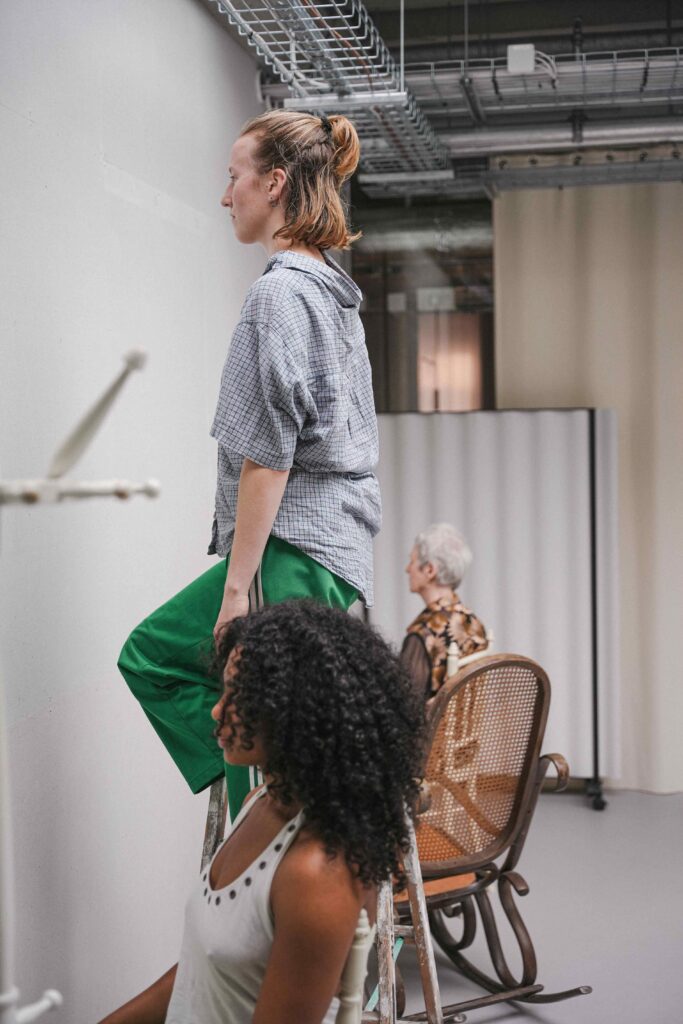
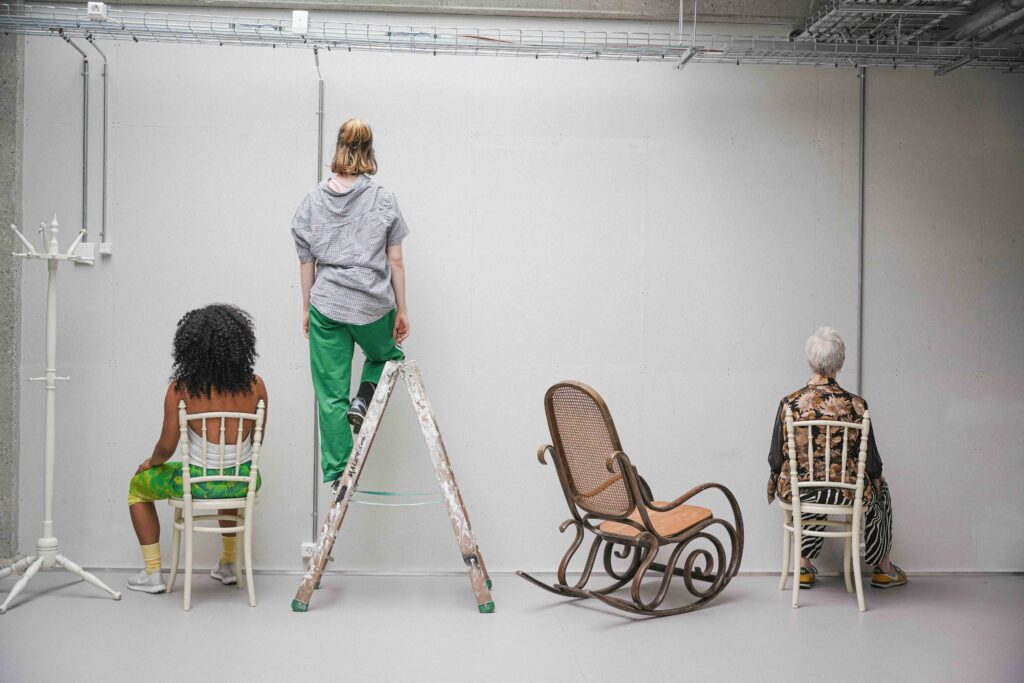
Several furniture stand in a row close to the back wall. The dancers are sitting and standing on the furniture facing the wall. This is a moment of silence after a long time of chaotic movements floating around in space. The silence is needed and well-placed right in this moment. The audience wait for something to happen. A slight anticipation hanging in the air.
Sissel moves her hand very slowly towards the rocking chair next to her. She places her hand at the chair, pulls the rocking chair forward and suddenly let it go. The chair rocks. Back and forward several times. The rocking chair cuts through the silence not with sound but with its movement. It is satisfying to watch the simple movement of the chair distracting what was a moment of silence and stillness
II.
The furniture has been moved to the front of the stage. The performers have once again placed themselves on the furniture, sitting on a latter, on two chairs facing the audience this time. Once again, the rocking chair is put to movement. The repetition is soothing. Then they start repeating a choreography of gestures. Underarm to the side, shaking the hands, turning a screw in the air, touching the face carefully. They repeat the choreography several times, not necessarily symmetrically but within their own personal rhythm. It is a moment of vulnerability. Suddenly Elisha stops the movements and moves her chair to the back corner of the room where the performers now one by one place the furniture upside down, on top of each other. It is like a failed landscape of furniture.
III.
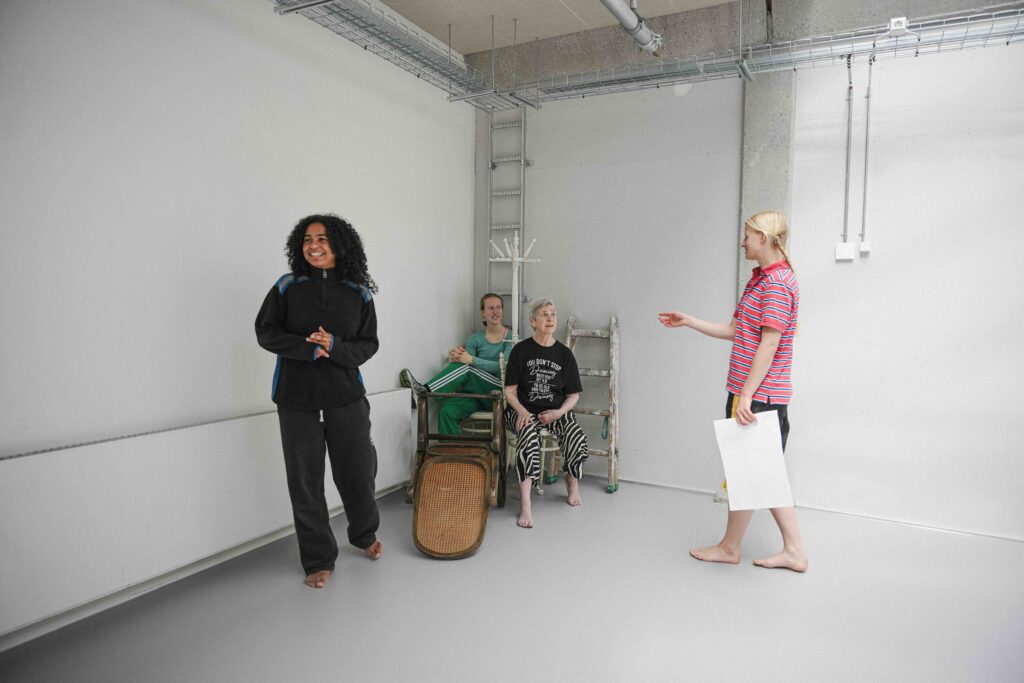
One moment of chaotic movements, deer jumps, stumbling around the room, falling carefully, smiling rapidly, echoing each other like shadows, showing off, presenting a situation, moving together, moving apart, lying down. It feels like a landscape of bodies, their generational span creating a nuanced way of watching the body. The body is fast, strong, soft, flawed, animalistic, sometimes perfect. This body is everything. At the same time, we hear a Swedish song beginning like this “den sommaren jag såg rakt in i dig”, reminding me of a long summer night being in love, swimming naked in the sea, making love, kissing, drinking wine, doing everything with this immensely beautiful and imperfect body. The movements of the performers are contrasting the soft love song at the same time they are a reminder of how awkward and wonderful and weird and not understandable love can be.
Audience feedback
Every HAUT residency ends with an audience conversation. Not as a way of giving feedback in a judgmental way but in a way where the artists can get feedback on the experience of the audience and from there move on with the development of the process. The artists asked three questions, and I have decided to share some notes and quotes from the feedback of the audience.
I. What vibe did you get watching the sharing?
Subtle, contagious, accidental, sparkling water, bubbly, Swedish summer, nostalgic, looking forward, a glimpse, nostalgia into the future, very long preparation, surprising, avoiding conventional solutions, caring, hectic, unintentional/intentional, strong, interconnectedness.
II. How was the audience contact?
Innocent, nonchalant, playful, playing with attention, catch my gaze (in case I was not looking), gaze is strong when looking away for a long time, gaze is strong when turning towards the audience, hidden spaces, presenting, membrane, being close or distanced, everybody having a secret, fast smiles, reading everything in terms of the sheep.
III. What moments did you wish you had spent more or less time with?
Mææh sound, music, rocking chair, repetition (important), gesture, tonus, high intensity, more of the soft tonus, skill of tonus, more of everything.
The feedback session ends with everyone in the audience being giving the chance to write a letter to the group of artists. The letter could be feedback not being giving during the open session, other notes, love declarations, a personal letter. The atmosphere is again filled with warmth and an unpretentious collaboration between artists and audience. Exactly how I felt when entering the space of Avilda, Sissel, Elisha and Thorunn for the first time.
I get to think about collaborative processes and how we actually allow other people to distract our artistic process or even life. I think it is a beautiful and unavoidable way of being in this world. We are distracted every day, all the time and if we allow for those distractions to guide us, maybe we flow just a tiny bit more.