Between 2020 and 2022, the collective trauma of cancelled plans and uncertainty had paralysed the global art community, where lives and social rhythms are often governed by project-based work scheduled across geographical space. Projects conceived then, and soon after, inherited a responsibility to salvage social fracture. In-Situ: Performance as Exhibition (Singapore, 4-6 April 2024; Manila, the Philippines, 15-26 October 2024; Penang and Kuala Lumpur, Malaysia, 22 November-31 December 2025), first conceived amid the global lockdown, is one of the progenies. Informed by methods of contemporary art public programming and the seasonal rhythm of the performing arts, this durational exhibitionary programme refuses stagnancy.
Curator Vanini Belarmino’s proposal is two-fold. Art, with a capital ‘A’, is in public space because the body’s movement is producing Art. Art exists as an active presence: its criticality is derived from realised social attention. Belarmino comes to this understanding as a good student of twentieth-century art history, especially Fluxus. The everyday experience of contemporary life in Southeast Asia is full, complete, already aesthetic. This was an understanding catalysed in local artistic sensibilities through late twentieth-century exhibitions such as the First Sculpture Seminar (May 1991, National Museum Art Gallery, Singapore), which featured an entire gallery of works by Joseph Beuys. The ideals of art as life and life as art were routinely reinforced in regional performance art festivals and groups such as Undisclosed Territory, Asiatopia, Future of Imagination, Womanifesto, Nippon International Performance Art Festival, Baguio Arts Guild, Chiang Mai Social Installation, etc. Further afield, interventions in Bienal de São Paulo and the Havana Biennale were critical alliances that reinforced social commentary and localised responsiveness as the building blocks of compelling contemporary art.
Penang, Malaysia, 30 November 2025. Photo: Geric Cruz
The curatorial strategy is thus to frame what has already always been present and to “transform the ordinary through movement, breath or gaze.” Belarmino wants us to go beyond looking: “listening”, “choreography”, and “rehearsal hall” are some words that Belarmino uses when discussing how the artists and works come together. High modernist interest in pure visual pleasure and post-modernist exploration of experimental performance is carefully placed aside. What concerns In-Situ are the tensions produced by human/animal/architectural relations in public space, revealed by the largely delegated performances of visiting artists Lilibeth Cuenca Rasmussen, Molly Haslund, Sophie Dupont, Filip Vest, Kai Merke, Christian Falsnaes, and Hesselholdt & Mejlvang, produced through the support of local artists and communities including Critical Craft Collective, Elizabeth de Roza, Urich Lau, Christine Crame, Ea Torrado, Daloy Dance Company, Jeremy Mayores, Kyle Confesor and Sasa Cabalquinto.
In A Void (Avoid), Cuenca Rasmussen re-enacts 11 canonical performance art pieces in Earl Lu Gallery, LASALLE College of the Arts, Singapore. With works by artists such as Shigeko Kubota (Vagina Painting), Yoko Ono (Cut Piece), and William Wegman (Deodorant), the fully clothed Cuenca Rasmussun opens In Situ as a capsule summary of the exhibition’s trajectory: Reflexive, piecemeal, and adapted to the locale.
Marking Breath by Dupont is a durational work that invites participants to observe their own breath misting on handheld, polished, metal plates. Continuing the inward journey of In Situ, Dupont marks each occurrence and disappearance of breath clouds with a precise scalpel knife. Whether sitting across her in LASALLE or jointly hiking Mount Makiling in the Philippines, her participants are guided in movement by the rhythm and tempo of their own breath. The artist is rendered an ordinary guide pointing toward the already present Art in the fundamental subsistence of life.
Yet what really grounds Berlarmino in situ, as it is, are the fundamental subsistence of societal function. Where In Situ shines is in the reframing of ready-made actions into performance. It could be as small as picking up what someone else had accidentally dropped or an unexpected gift of fresh flowers, as Haslund’s Flower Drop exacted in Manila, the Philippines. Conducted unannounced, this performance realises visibility through the unplanned connections with people on the streets of Intramuros.
The collective, unconsciously unplanned alignments of behaviour is thematized by Falsnaes in FRONT, performed as part of the respected Georgetown Literary Festival’s closing programme. At Cheah Kongsi, Falsnaes rallies his audience into producing spray paint art, breaking down the panels, and reinstalling the pieces in collaged form. Cheah Kongsi is an ancestral building from the British colonial period, a home for the extended Cheah clan. It remains in private hands today, albeit with a reasonable public engagement interest. Unlike in Intramuros, Falsnaes’ audience knew exactly what they were doing – collaborating in a performance-installation. The exhilaration is shared synchronously in the loud noises and physical exertions of all. The new monument remains erected on the grounds of Cheah Kongsi in realization of the subtitle of Belarmino’s project: Performance (made) as exhibition.
Belarmino’s proposal is part of a by-now long and established trajectory of postcolonial art and exhibition practices in the region that seeks to orient the definition of contemporary art practice to one that remains fluid across different artforms: visual, theatrical, literary, or otherwise. It has been informed by movements and experimentation happening in Europe. It has been reinforced by solidarity among nonaligned sympathies. It is also borne from extended critical evaluations by artists searching for an artistic language from local life.
Wong Hoy Cheong’s 1994 Lalang project in National Art Gallery, Kuala Lumpur, come to mind. In this multi-day performance contextualised in the group exhibition Warbox Lalang Killing Tools, Wong was a seemingly ordinary gardener manicuring the lawn, removing lalang grass (also known as cogongrass) and replanting cow grass. Such works draw attention to an everyday action – gardening – as metaphor for societal change. Melati Suryodarmo’s I Am A Ghost in My Own House (2012) has her crushing and grinding charcoal for 12 hours, its erosive rhythm guided by the expirations of her own body. Together with twenty-first century slow cinema works of auteurs such as Lav Diaz and Apichatpong Weerasethakul, the latter also well-known for his immersive installation artworks, the sites are primed to receive In Situ’s proposal for aesthetic life and durational mindfulness without losing sight of socio-political critique.
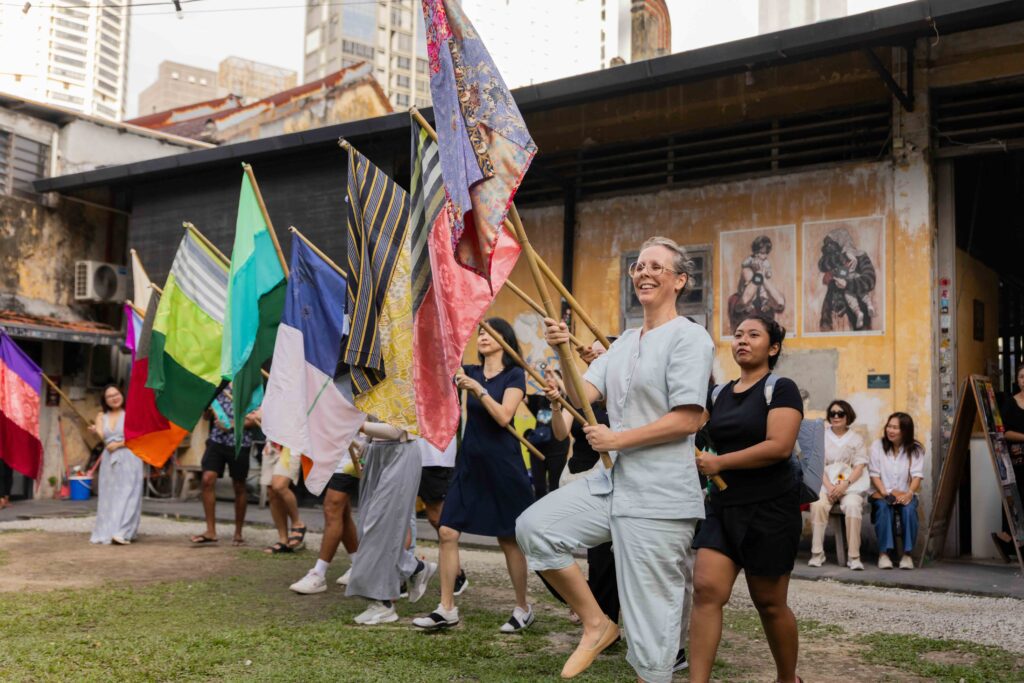
There is also visual resonance. At Hin Bus Depot, Penang, Hesselholdt & Mejlvang presented Be a beautiful force together, a workshop-and-performance piece that questions the flag-waving masculinities on the international stage. Penangites were invited to bring their own textiles, saved from old clothes or home furnishings, and collaboratively repurpose them for these flags over a making workshop. These flags were christened in a light-hearted march choreographed by the duo one week later before its final installation as vertical flag bunting in China House, the local café, restaurant, bar, and arts centre. Hung overhead, Hesselholdt & Mejlvang’s installed Force recalls the proud collegiality expressed by flag collections in backpacker lodges and drinking holes. The use of flags clearly recalls Arahmaiani Feisal’s ongoing Flag Project (since 2006), similarly interested in the call to peace.
November 2025. Photo: Geric Cruz
Other regional works come to mind. In 2009, Lee Wen re-enacted Nam Jun Paik’s Zen for Head (1961) in Sculpture Square, Singapore, the third in his series of re-enactments (the first was Yoko Ono and John Lennon’s 1969 bed-in, the second was Yves Klein’s Anthropometries. Like Cuenca Rasmussen, who made the re-enactments her own, Lee used an everyday mop and clay instead of Korean sumi ink. In both instances, the audience were the art historically informed, practitioners who immediately understood the homage for what it was. Where Lee’s modifications was informed by his understanding of Paik’s cultural relationship to sumi ink, Cuenca Rasmussen’s concerns were practical and interpretive.
I point these alignments to draw out Belarmino’s potential critical intents. In introducing unfamiliar artists from a distant geography through works that reflect shared artistic languages, Belarmino provides the local audience in Singapore, the Philippines, and Malaysia with manageable points of comparison. Where Arahmaiani is interested in global pressures on local practices, Force is more concerned with nationalist divisions. Where Lee was thinking through how Head for Zen could be translated to the Singaporean context, Cuenca Rasmussen is considering the canon of performance art. A Void included an additional original performance by the artist, where she dressed in a customised white pencil dress and chunky white sandals. Standing on her own shoe-pedestals while validating the audience’s attendance with a blue marker, Cuenca Rasmussen’s performance in the local art academy reads to me as a question of what becomes part of art history and as a reflection on anxieties around who has been recognised as an art practitioner or art expert.
My reading of A Void at LASALLE is further informed by the event it accompanied: The Launch Symposium for academy’s new BA (Hons) Art Histories and Curatorial Practices: Asia and the World. Celebrated as a milestone to the notoriously pragmatic nation’s increasing support for the arts, Cuenca Rasmussen’s performance practice-as-art-history had the declarative effect of validating artistic/curatorial practice as the authoritative form for regional art history. As the opening performance, A Void directly mirrored Falsnaes’ FRONT, which closed George Town Literary Festival (GTLF) in Penang, and the programme’s postscript as a white cube exhibition in Ilham Gallery, Kuala Lumpur.
The institution remains present, often visibly so, from In-Situ’s sites. In Singapore, performances were limited to LASALLE’s city campus. In Manila, performances were held in the Cultural Center of the Philippines complex, Manila Metropolitan Theater, and Intramuros, architecturally marked by Spanish colonial legacy. In Malaysia, In-situ is co-programmed with George Town Literary Festival in Penang, one of the leading literary festivals in the region, in the officially governed Penang Art District within the UNESCO World Heritage site of George Town, and concludes with a formal display in Ilham Gallery, a respected non-profit gallery at the centre of Kuala Lumpur. The entire programme also receives support from the Danish Arts Foundation and the New Carlsberg Foundation.
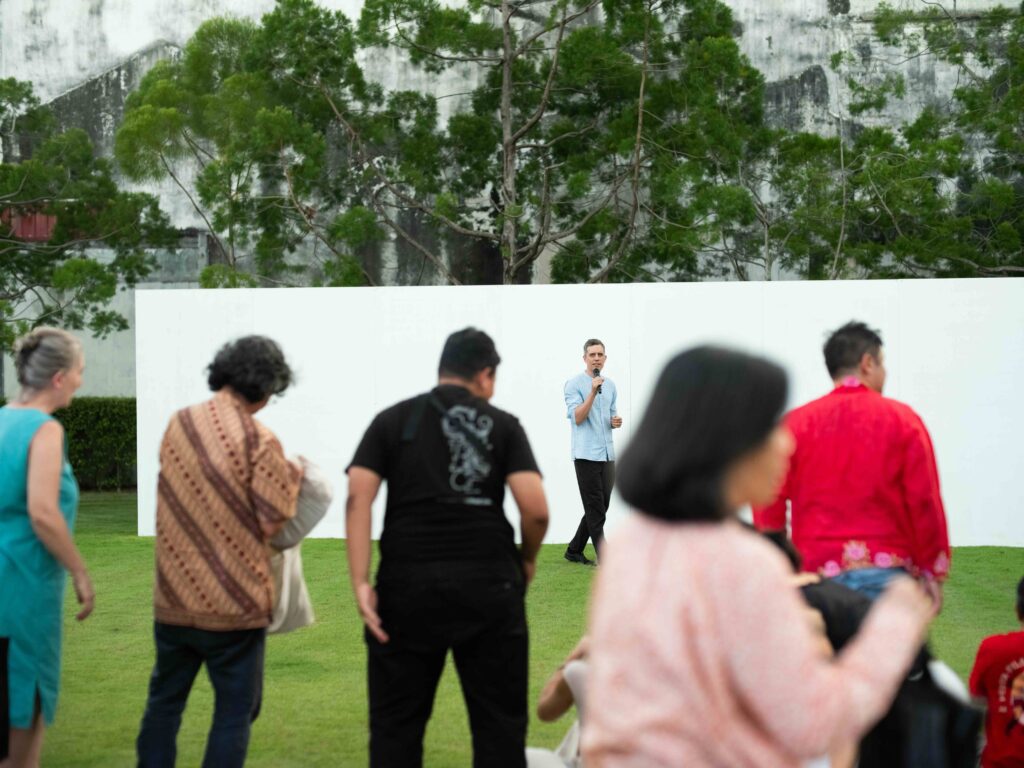
Photo: Geric Cruz
In Situ’s reliance on brick-and-mortar institutions raises questions on how the project should be understood. Consisting primarily of live performance and, in at least 2 locations, in conjunction with existing programming, it methodologically echoes museological public programming, where the activities are related to the ‘main’ event (static exhibition in the gallery). This is familiar ground for Belarmino, who was previously assistant director for Programmes at the National Gallery Singapore. There, the primary metric had been quantitative: The number of events delivered in the year and the total number of people engaged in each event. Yet the cross-festival, cross-city, multi-year ‘public programme’ of In Situ surely exceeds such a minor dismissal. Some performances further deviated from this structure. Haslund’s Infinite, a breathless beach march of the infinity sign with Ea Torrado and the Community of La Union in San Juan, 276km north of Metro Manila, and Dupont’s hike in Mt Makiling 78km south, were more remote.
In fact, a reflection of how the performances have been structured more closely reflect the seasonal nature of touring theatrical programmes. Its first iteration in Singapore, April 2024, focused on engagement with the already-inducted art community; the second iteration in the Philippines, October 2024, took to the streets with artistically-charged architecture in its backdrops and adapting to Super Typhoon Kristine in La Union; in the third iteration in Penang, November 2025, In Situ developed a story of what was and could be, simultaneously nostalgic for a simpler time and a caution for the challenging nuance it hid.
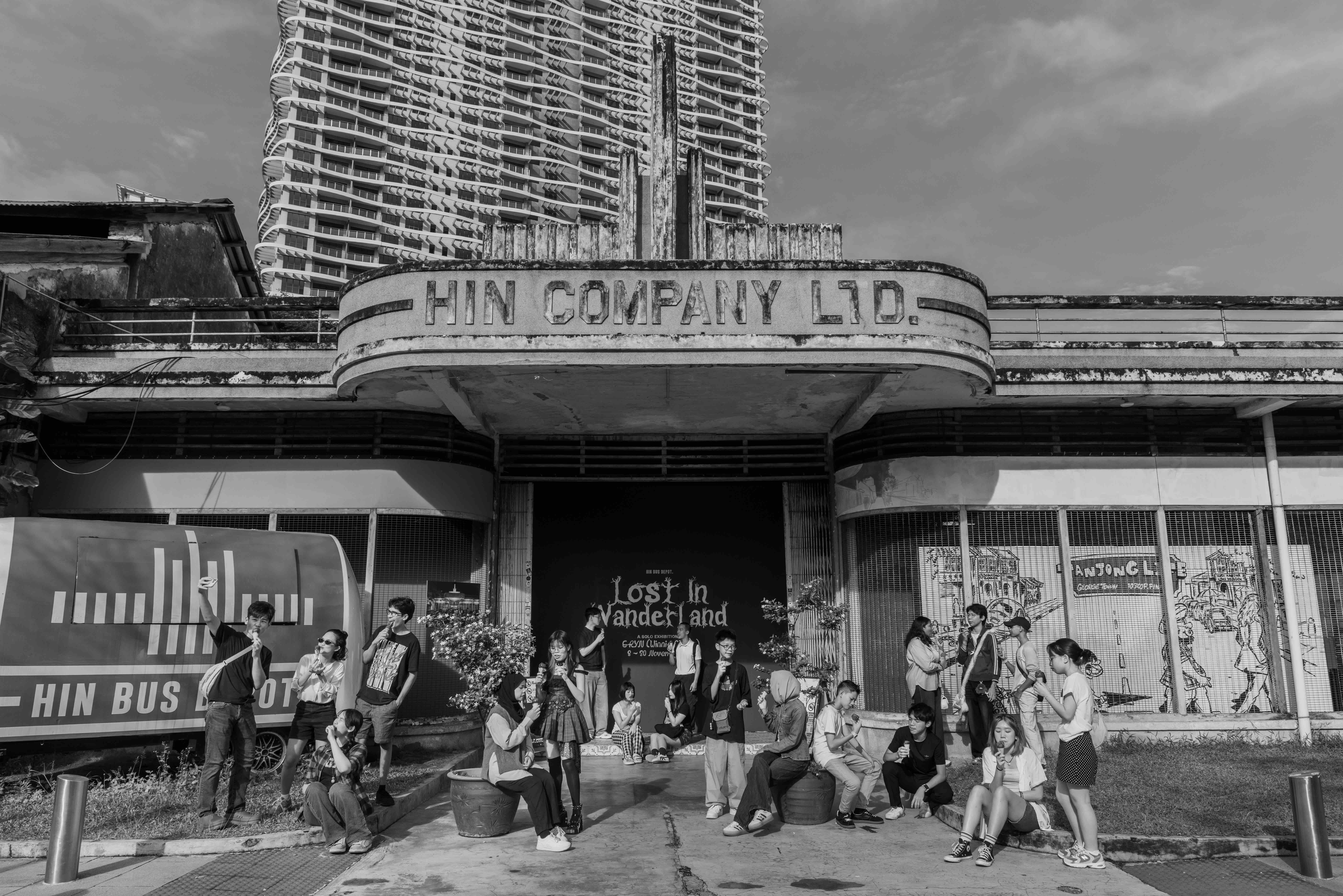
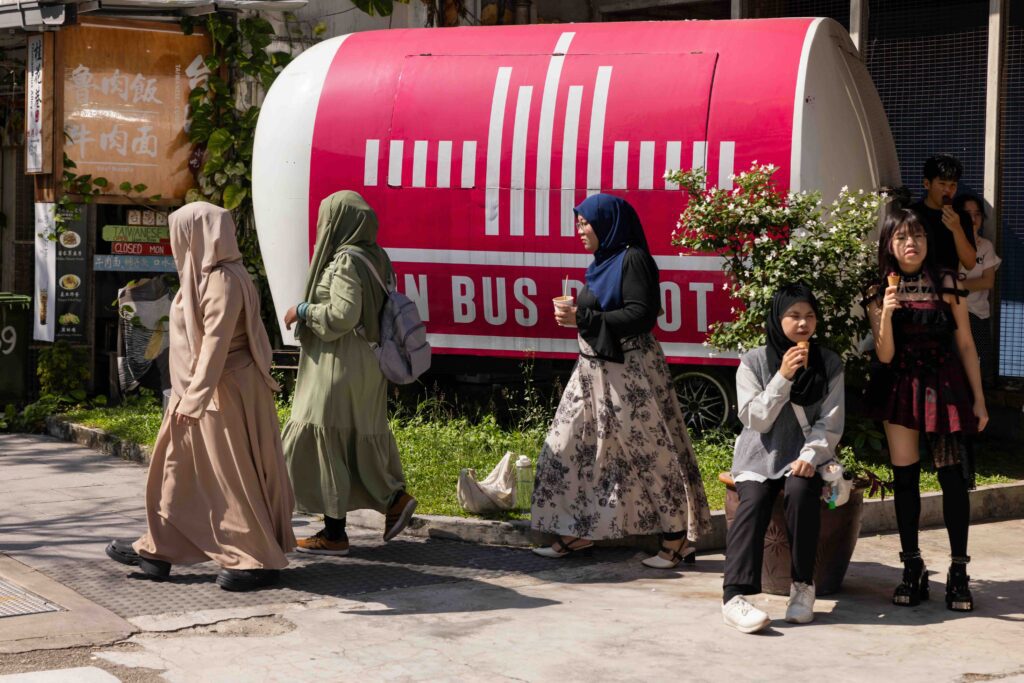
Coming full circle as a postscript, Molly Haslund’s Teenagers Eating Ice Cream Cones will now need some discussion. Previously only performed in the Nordic context, this performance-after-photography involved a carefully dressed group of local teenagers occupying the entrance of the gallery while eating ice cream as if unaware of where they were and the impact they were making. The scene is photographed and exhibited in the gallery. The same teenagers in the exact same clothes return to occupy the very same positions they did before on a separate, advertised, performance day. The theatricality is thus made evident: In the second, third, or however many, iterations, these same teenagers continue to feign ignorance of their surroundings. Teenagers was presented twice in Malaysia: In Penang, at the entrance of Hin Bus Depot, and in Kuala Lumpur, at Ilham Gallery. This is also the only work shown in Kuala Lumpur, serving as In Situ’s final word.
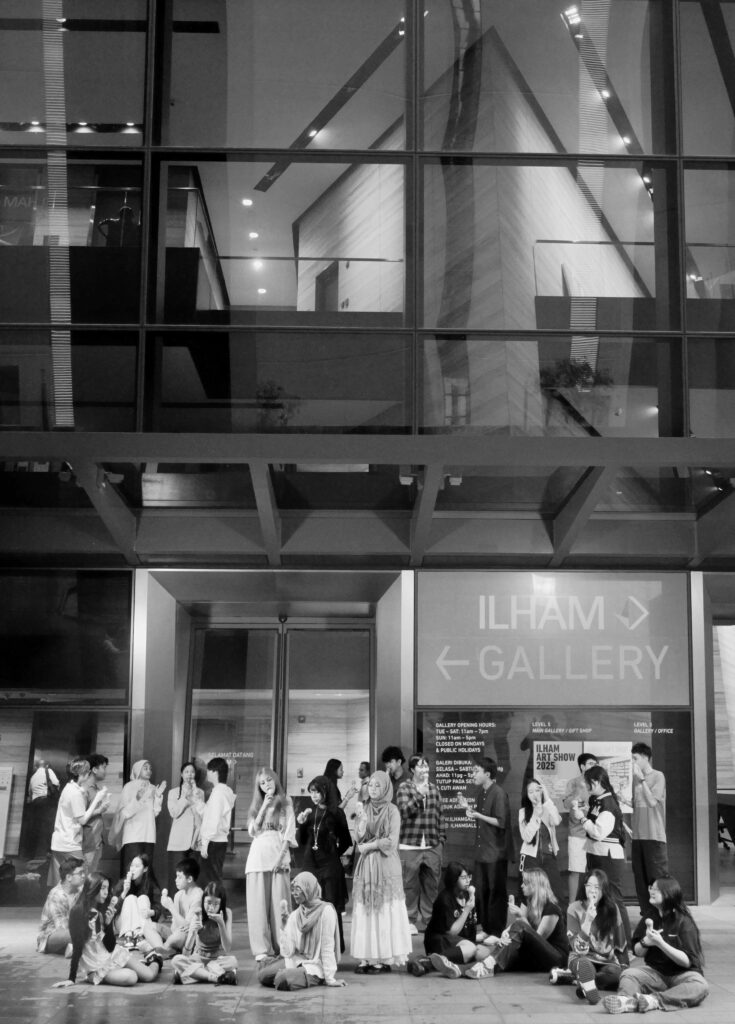
Pre-performance documentation realised in collaboration with Sherman Ong
The season-based, iterative, nature of performing arts programming does have its benefits for a live art project. Meanwhile, in a reversal of the expectations for museological public programmes, In Situ’s collaborations consume the site’s primary audience. By and large, the people who were already interested and going to these places were the ones most drawn to In Situ – myself included. There is a distinct pleasure to how In Situ integrates with my attention with Singapore’s burgeoning higher education offerings for art history and curatorship, and my annual forays to GTLF.
Art is life and life is art, says Joseph Beuys. To take him seriously is to consider how the In Situ project integrates with everyday regional life, and with whose lives. My travels were not unique, as the many like-minded friends and colleagues I met in GTLF proved, though my attention to Belarmino’s 2-year, 3 and a half-part, programme might. Low on high theory and the mystification typical of a certain type of curation, its straightforward presentation and even more straight-shooting subtitle – Performance as Exhibition – is in line with the desire to platform artistic practice over curatorial obfuscation. This demonstrative proposal is perhaps what makes In Situ most curatorially interesting: It’s literal practice. Everyone could dream up a multi-city, transnational, exhibition project with artists unknown to the region. It takes a certain skill, a confidence in scale, to actually achieve this at the level of In Situ.
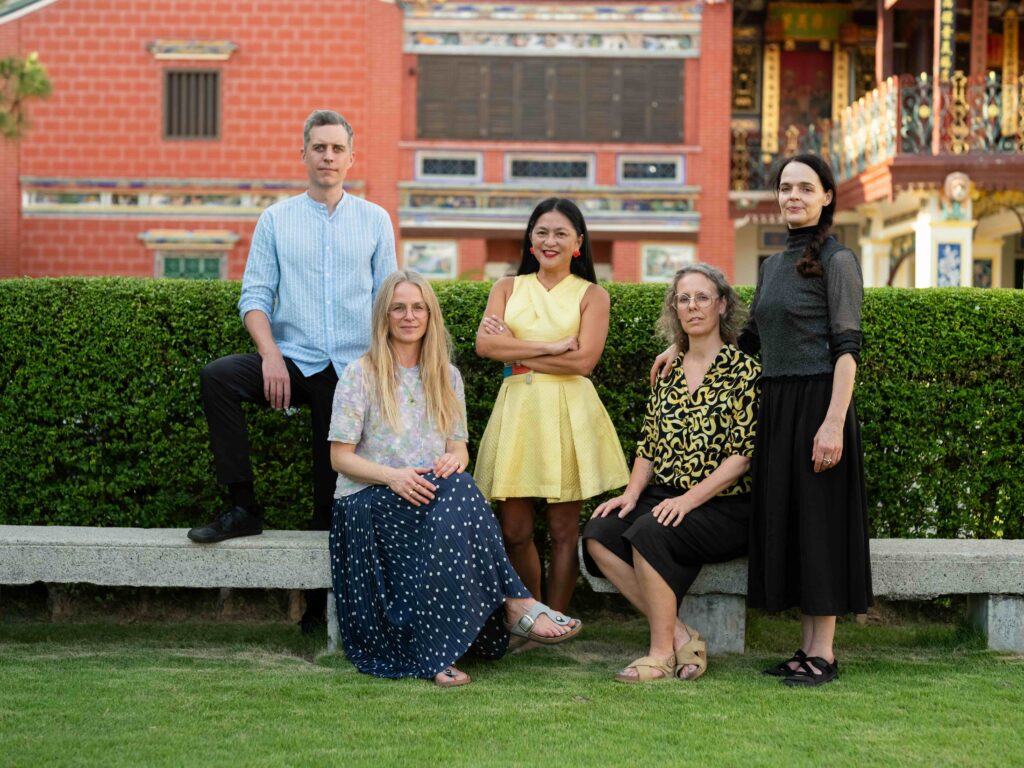
Edition, Christian Falsnaes, Vibeke Mejlvang, Vanini Belarmino, Sofie Hessleholdt and Molly
Haslund. Photo: Geric Cruz