– a roaring kaleidoscope of fairytales, queer desire, humor and darkness, afrofuturistic voices and visibility: NEON BEIGE by Alen Nsambu
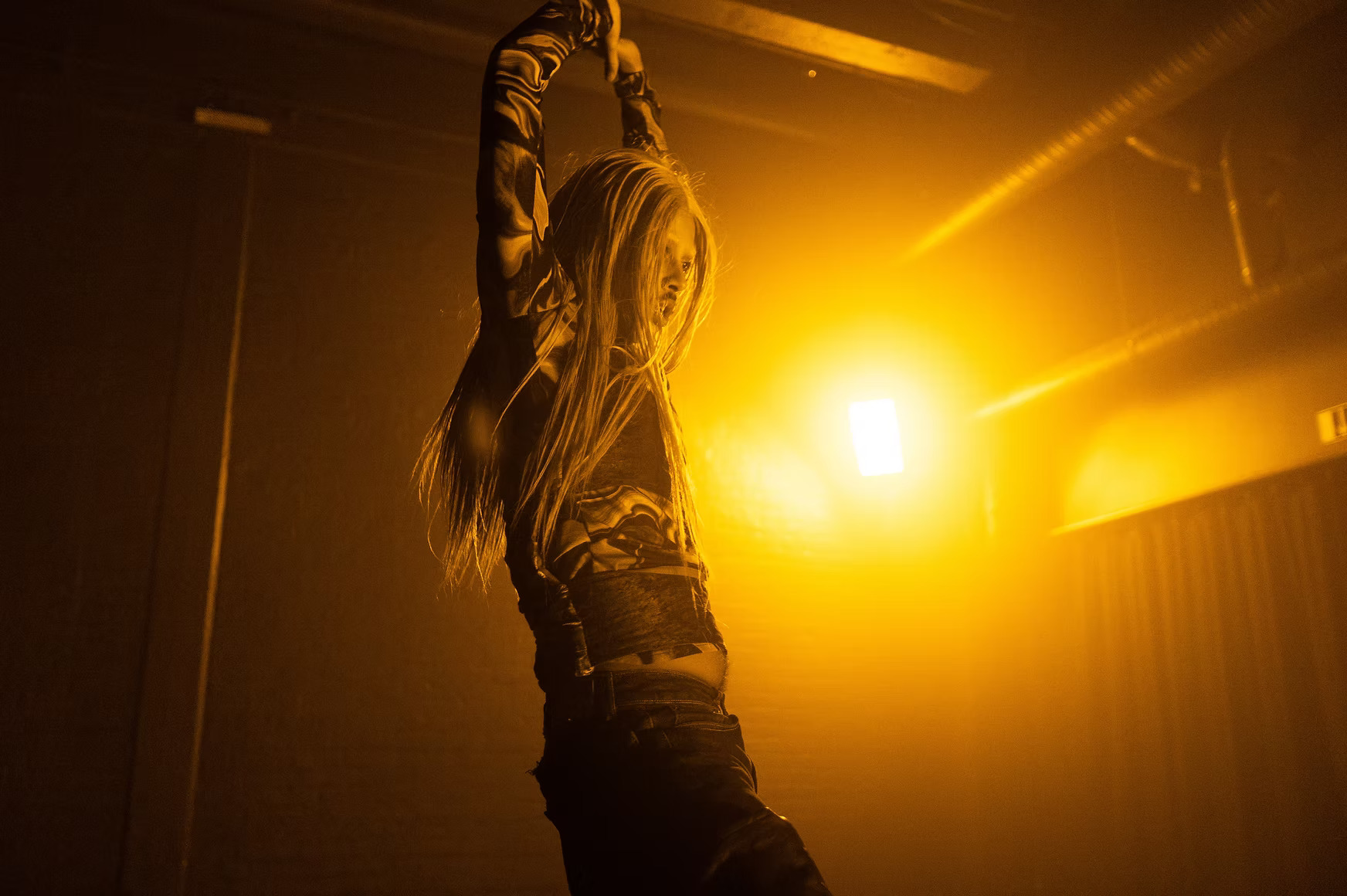
A strong beat is coming from the speakers along with a voice singing: “DO YOU LIKE BOOM BOOM BEIGE?“ Alen Nsambu wears a long blond, or rather beige wig. Their back is turned to the audience, they step from side to side, moving their hips. There is a small window cut out of their jeans right above their butt cheeks. They are switching places. With wide steps on the spot, their hand is reaching out in front, clasping together over their head stroking down their face, throat and chest.
On November 5th, Alen Nsambu is showing NEON BEIGE in Copenhagen for the first time – a solo they developed and premiered at Zodiak – Center for New Dance, Helsinki in 2024. The stage is almost empty – except for a wig, a tube of nivea sun-screen, a speaker in the back and a pair of high-heeled stilettos. Knee-pads show under Nsambu’s jeans. Their shirt has camouflage-like colours and their mustache and eyebrows are dyed beige, just like the extensions in their braids. Alone on stage Nsambu creates a piece that interweaves their own experiences, dreams and different portraits of themselves with myths, pop culture phenomena, highlighting misogynist and racist structures in society, using theatrical means and Afrofuturistic aesthetics.
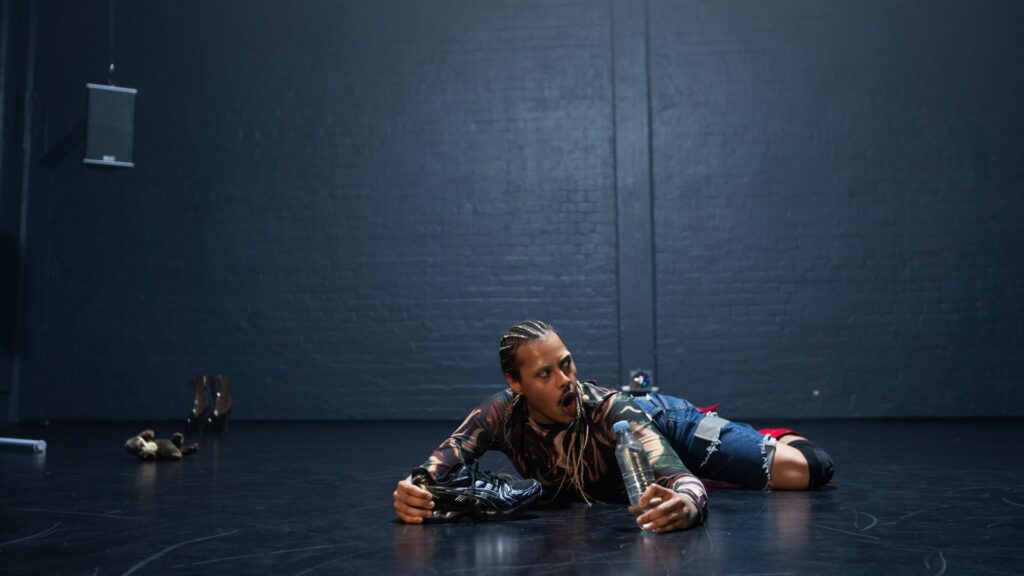
Nsambu sits down next to the audience, puts on a portable microphone, rummages through a garbage bag for his props and small-talks with the audience. They put on red lace high-heel stilettos and mention that they like Danish water better than the water in Finland. It’s because of the chalk inside they say. This is how they become the wolf and Red Riding Hood all together. The scene opens up into a puppet-play, circling around the fairytale of Red Riding Hood interlinked with dating experiences and day-to-day racism: The waterbottle, aka the wolf, in his left hand and his sneaker, Red Riding Hood, in his right. They want to go blackfishing (Blackfishing refers to white people altering appearance to appear Black or mixed-race to appeal to a broader audience. They systematically mimic traits People of Colour are looked down upon e.g. dark skin, curves, big lips), compare their skin tone to different coffee colours and go to search for the biggest Black cock in the audience.
Alen Nsambu and the puppet-play of Red Riding Hood. Photo: Aino Kontinen
Alen Nsambu [AN]: “This segment of the work started with the red heels. I started wearing them at rehearsals and was like “oh it’s giving Red Riding Hood.’
It’s a tale I heard in my childhood and I started looking into it again. I thought of the wolf as a connection to gay stereotypes, which are these categories of otter, wolf, twink, bear and connected it to experiences I had on Grindr, the dating app.
There is a lot of exoticization, fetishization happening of Black gay men. I started using messages I have gotten on Grindr and built this scene on stage – like a fairy tale. The Red Riding-Hood wandering alone through the scary forest is me wandering through these dating apps looking for love among other things.The wolves are people that have messaged me and started conversations with racist things. There is a character that says’”I’ve never really hooked up with a non-Caucasian guy before. It was kind of hot.’ That was a person that I met once. After meeting up, he said, ‘You know, Black guys are normally not my type, but you’re kinda cute. It’s just my preference.’ He did not realise how ingrained in racism it was. Instead he said, ‘Take it as a compliment.’
In those settings, you’re hypervisible and at the same time you’re simplified only to your race or skin color. You become fetishized or exotified. The same time you become hypervisible, you become invisible, too. It relates to one of our first ideas for NEON BEIGE. We knew we wanted to work with monochromatic light. We use orange light that washes away all colours except orange. Anything in the orange colour-spectrum becomes hyper-visible, but everything else becomes invisible.”
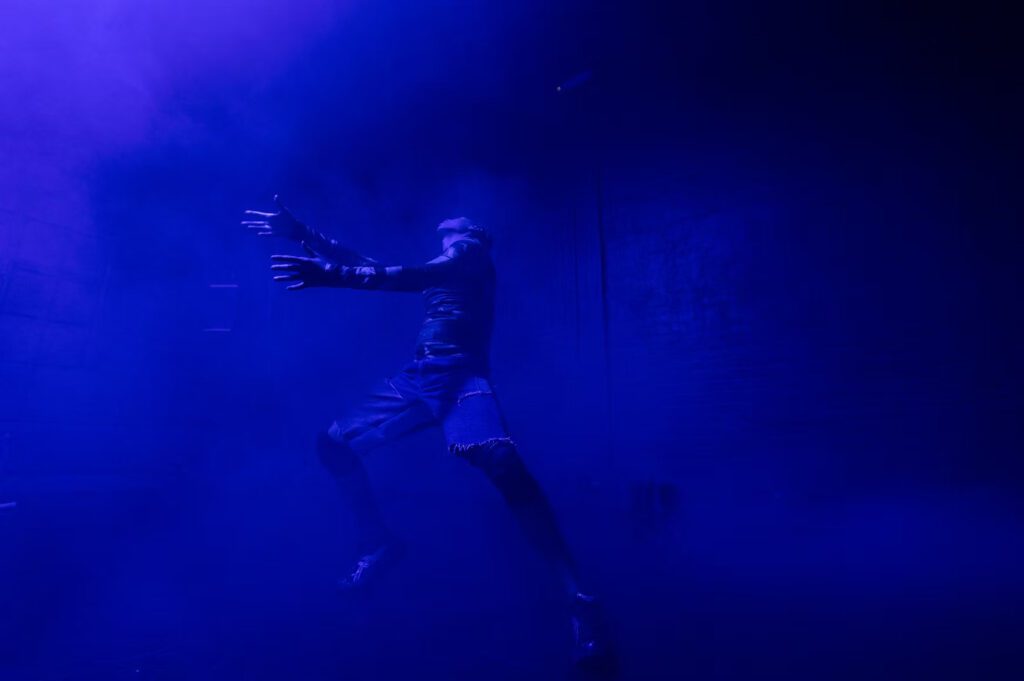
The lights are fading out and more and more fog is hovering above the ground and filling the stage. Nsambu looks at their hands gliding through the air in front of them, disappearing eventually. It becomes dark and only the fog looming in the room is still graspable. A high-pitched tone is coming from the speakers and a siren wailing in the background. One can detect Nsambu’s footsteps. They go faster and out of the sudden Nsambu appears right in front and very close. Their shoes make a squeaking sound as Nsambu stops and their dark silhouette appears large against the mist.
AN: “The first part, disappearing in the mist, is a score for me. It is both visual and a physical score of making my body parts fade away and disappear visually in the smoke, and also working with the imagination of my limbs dissolving and my own outlines becoming blurry.”
AN: “I am being seen by the audience, but I am seeing the audience, too.
I did not want to create an imbalance, where I’m the only one being spectated. I’m also seeing you seeing me. I don’t want the audience to become solely passive, that as an audience member you escape into a backspace of darkness. I wanted the audience to sit in a way that they could see each other and become part of the whole performance as performers in a way. And then I play with what versions of myself I give out to the audience. It gives me a sense of agency and power to be the one choosing that. So it is not being imposed on me from the outside. The first time I speak in the performance, I am using a voice filter. People who don’t know me may think that’s my real voice. But then it’s not.”
With fixed eye-contact Nsambu sits in front of the audience. They take the bottle of sun-screen in one of their hands and then they let it disappear behind their back. They hold their hands – fingers wide spread – to the side: nothing there. Later with a huge grimassing smile, they will make the sun-screen appear again.
AN: “In the beginning of NEON BEIGE I play with a gloomy character, I call it the lurker. The character is born from the stereotype of a “threatening” Black male and how I feel like I’ve been put there many times and how that specific stereotype is causing me to alter my own behaviour. Now I am playing with that: I can be mysterious or gloomy without being evil. I am doing funny tricks, like making something disappear and appear again. I’m not showing what my intentions are, I’m not showing you my cards, but without a sense of evilness. It’s fun for me, because that’s something that I don’t get to do so much in like real life somehow. At least I haven’t so far.”
Nsambu approaches the audience lasciviously. Slowly they are crawling over the stage on all fours. They look directly into the audience’s eyes with a stern face and move along the people’s shins sitting in the front row. Still watching the audience their lips begin to move, while music is fading in: “Ride it, my pony/ My saddle’s waitin’/ Come and jump on it.” Leaving the audience behind Nsambu spreads his knees wide, propped on their forearms – face down, their pelvis up. A hissing white noise is coming from the speakers. They begin rocking front and back while waving his hips subtly. The image itself moves from Nsambu being stuck, thrusting their hips and grinding the space above the floor or getting ready to jump. A little later they are approaching the speaker hanging from the ceiling. They dribble, perform a slow-motion lay-up shot into the basketball net and hit.