Dear bastard reader,
This text is split in two. One part written at the preview of the Venice Art Biennale in May and the second part written during a second visit in September. The first thinks with performance-related works and the second thinks with live performance works.
Please don’t hesitate to reach out if you want to think together about any of this. Especially if you disagree with me.
xoxo,
Adriano
Adrianowj at gmail.com
PART 1 – 9TH OF MAY 2026
ANGA strike may 8th 2026. Photo Adriano Jensen
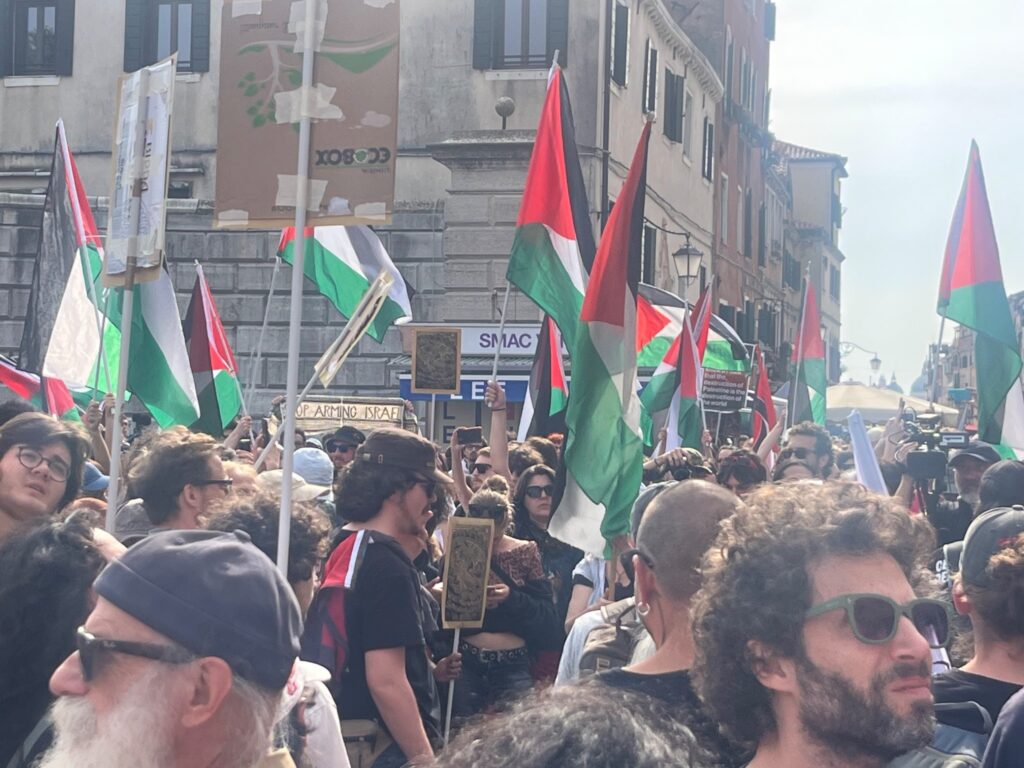
Yesterday, on the last day of a more-than-usually-overwhelming Venice Art Biennale preview, something hopeful happened. The ‘art-not-genocide-alliance’ (ANGA) coordinated a strike in collaboration with local workers-unions. Many pavilions closed to protest against the ‘art-washing’ that is Israels participation in the biennale while committing genocide. In the afternoon hundreds, perhaps thousands, marched down Via Garibaldi and then up towards the Arsenale, the exhibition area where Israel’s temporary pavilion is located, attempting to block its entrance. Sure, between chants of PALESTINA LIBERA and NO ARTWASHING some compulsive networking rippled through the sweaty art-crowd. And yes ANGA’s lack of solidarity with Ukraine is disappointing. But I had not imagined that form of collective manifestation in the ruthlessly competitive and individualistic Venice Art Biennale preview days.
The strike was (by far) not the only protest the last days: Pussy Riot organised several actions against the reopening of the Russian pavilion, the Baltic pavilions organised a walking protest with the same aim. The jury–the people who chooses who gets the fancy golden lion award–published a letter stating that they wouldn’t consider “countries whose leaders are currently charged with crimes against humanity by the International Criminal Court (ICC)” (effectively Israel and Russia). And following a backlash to this decision, the entire jury resigned. Plenty of artworks, performances, speeches and street art testified to protest.
Antonia Majaca wrote a helpful text about the problematic history and present of the Venice Art Biennale. And several cultural workers seem to think the colonial and capitalist structures that still shape the Biennale make it beyond repair. While I agree with that diagnosis, I also think this monstrous gathering of institutions and para-institutions do make a plurality of artistic practices available for a very large audience. So as a believer in transnational conversation and collaboration I remain interested. And as an artist working through dance, I am very interested when dance and performance has a strong presence at the Biennale. It did this year.
About 10 years ago there was another strong momentum for dance and performance in the visual arts. At the Venice Biennale this was expressed by Tino Sehgal winning the golden lion in 2013 for yet untitled, a work where performers sing, move and beatbox for the duration of the opening hours inside a gallery. That same year Alexandra Pirici and Manuel Pelmuş’ presented An Immaterial Retrospective of the Venice Biennale in the Romanian Pavilion where performers physically re-enacted artworks of the biennale history. And Raimundas Malašauskas blurred the lines between curation and performance with the playful Oo Pavilion for Cyprus and Lithuania. The title itself is a performance by Krõõt Juurak who changed their name to KrOot and offered the Oo as a venue for other artists. The Oo pavilion featured amongst others Maria Hassabis INTERMISSION which was the first in a series of ‘live installations’ featuring meticulous and very slow choreographies performed at major visual arts venues globally.
In 2015 Dora Garcia presented The Sinthome Score, a score for two performers who are performing for each other in the exhibition space: one by reading aloud a translation of a seminar by Jacques Lacan and the other by dancing through a series of poses. And Isaac Julien presented Das Kapital Oratorio, an epic live reading of all three volumes of Karl Marx’s Das Kapital Capital) performed episodically three times a day throughout the duration of the biennale.
In 2017 Anne Imhof won the golden lion for Faust, an opera-performance-installation continuing her research into the tension between art, fashion and power. Faust accentuated the fascist architecture of the German pavilion by adding fences, guard dogs and bouncers. The performers were models and model-like dancers. Between posing, and occasionally singing, they would continuously withdraw and disappear (behind a fence, under a glass floor, out of a window). Both the architecture and the choreography made the performance hard to capture. And the harder it got, the more visitors wanted it. The line got longer and inside visitors could be seen chasing performers trying to capture them with their camera phones. Even if I was too proud to participate in such hunts, the work stimulated and as such ‘staged’ unflattering desires inside myself.
In 2019 another opera-performance-installation in a national pavilion won the golden lion: Sun and Sea by Rugilė Barzdžiukaitė, writer Vaiva Grainytė and artist and composer Lina Lapelytė for the Lithuanian pavilion. Sun and Sea was a looped opera performed on a fake beach, and was viewed from balconies above. A bit like looking down into an aquarium. To fill the beach professional performers were mixed with volunteer performers who got approached outside the pavilion and asked if they would spend an hour or two hanging out in the sand.
The Covid-19 pandemic collapsed the performance trend–until this year–it seems, performance is back and on an unprecedented scale: in Venice three national pavilions present performances that are scheduled to be (more or less) ongoing during the 6 month biennale. It is a very expensive thing to accommodate and employ professional performers over such a duration and it is not surprising that 3 rich European countries host the proposals: Belgium, the Netherlands and Austria.
I want to write to you about these performances, but as I am sitting on the back-row of a ‘vaporetto’ (water bus) a man next to me is scrolling through a mix of memes and hardcore porn on his iPad. Slightly distracting. His scrolling stops, and a GIF of virtuosic anal intercourse loops in the corner of my eye, competing with these words for my attention. Inevitably I feel my pulse rise and some kind of heat in my chest. I will take another detour before writing about the performances, because this situation resonates so well with a performance related video installation presented in the Danish pavilion.

Things To Come by Maja Malou Lyse and DIS explores the effect of images, specifically porn images on human bodies. An immersive video work where porn actors “reunite” and perform more or less absurd actions: a bare chested actor with hard nipples using his spectacular chest muscles to play the piano. Several videos of actresses with gravity defying proportions running naked. And a strange prosthetic blowjob, as one actress brushes the teeth of another, holding the toothbrush between her own teeth and moving her head back and forth: These videos portray porn actors whose bodies–like athletes–are shaped for and by performance. The performance at stake is porn, and appropriately the actions of the video are strangely sexy and technical (torso piano play, mouth to mouth toothbrushing), and they are lit and framed in ways that reveal a vulnerability that doesn’t usually make it to the pornographic image, but which nevertheless is produced by its performance. Apart from presenting and celebrating performers of ‘low culture’ (porn) within ‘high culture’ (visual-arts), the work offers a situation where the visitors can sit (albeit without chairs) with the ambiguity of ‘strangely sexy’ and vulnerable bodies shaped by performance for the camera. Possibly the actors in Things To Come are exemplary of bodies emerging in what Paul B. Preciado calls the ‘Pharmacopornographic Era’. Or maybe closer to home: If ‘post-performance’ in performance art is the moment when secondary circulation through social media becomes more important than the first hand experience of the work, then Things To Come invites us to turn our attention back to the bodies of the performers ‘post-image’. Paradoxically (or not) through a large scale immersive billboard video.
Now the guy with the Ipad got off the boat and Venice is disappearing in the horizon. There is another performance-related video installation I want to write to you about before getting to the performances: Elegy in Venice by Gabrielle Goliath: This work was planned to be presented in The South African Pavilion, but it got cancelled after the South African minister of Sports, Arts and Culture Gayton McKenzie attempted to censor a tribute to Hiba Abu Nada, a 32 year old Palestinian poet killed in Gaza by an Israeli airstrike in 2023. Thankfully it was realised in a church as an independent exhibition.
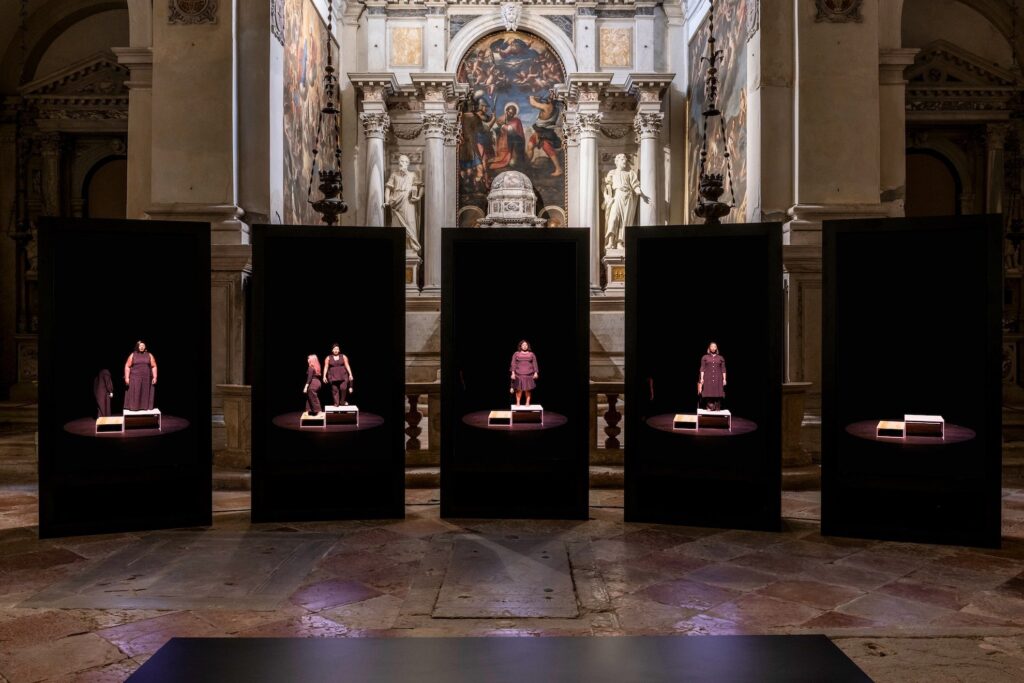
Elegy is a “life work of mourning… It is a cry, a lament, a tender refrain of remembrance, repair, and black feminist love.” The first Elegy took place in Cape Town to grief the rape and murder of 19 year old Ipeleng Christine Moholane; “Each performance gathers a group of seven opera singers who collectively enact a ritual of mourning, sustaining a single haunting tone over the course of an hour“. Only one singer sings at the time, standing on a small podium lit by a spotlight, the other singers stand in line behind her, ready to take over.
For Elegy in Venice three performances of Elegy are presented simultaneously on eight monolith video monitors; one commemorating Hiba Abu Nada, another commemorating Ipeleng Christine Moholane and a third commemorating two Nama women, displaced and killed in the Ovaherero and Nama Genocide (1904-1908). The latter was staged for the Venice Art Biennale 2024.
Stepping into the imperfect circle of Elegy in Venice, listening to eight opera singers each holding the same tone, and seeing them repeatedly replace each other on the screens was powerful. ‘Form’, ‘relations of production’ and ‘content’ neither conflated nor dissociated, but holding each other in a tension which filled (and still fills) that church. The ‘form’ as the relentless tone, the ‘relations of production’ as the collective effort of the singers to hold it and the ‘content’ as the mourning itself. Without making a spectacle of suffering, the tension holds space for mourning racialised genocide and femicide. For the opening of the work a resonant participatory performance was proposed: 120 people had signed up in advance to read one minute each from a poetry collection (the elegy reader). This format allowed for a large number of visitors to contribute with their voices and a sense of carrying the work collectively. One reader quoted Baldwin: “The children are always ours, every single one of them, all over the globe; and I am beginning to suspect that whoever is incapable of recognizing this may be incapable of morality.”
A quote which Swedish choreographer Pontus Pettersson advised me could bridge this text to yet another performance-related-yet-not-live-performance proposal: Grass Babies, Moon Babies by Ei Arakawa-Nash for the Japanese pavilion.
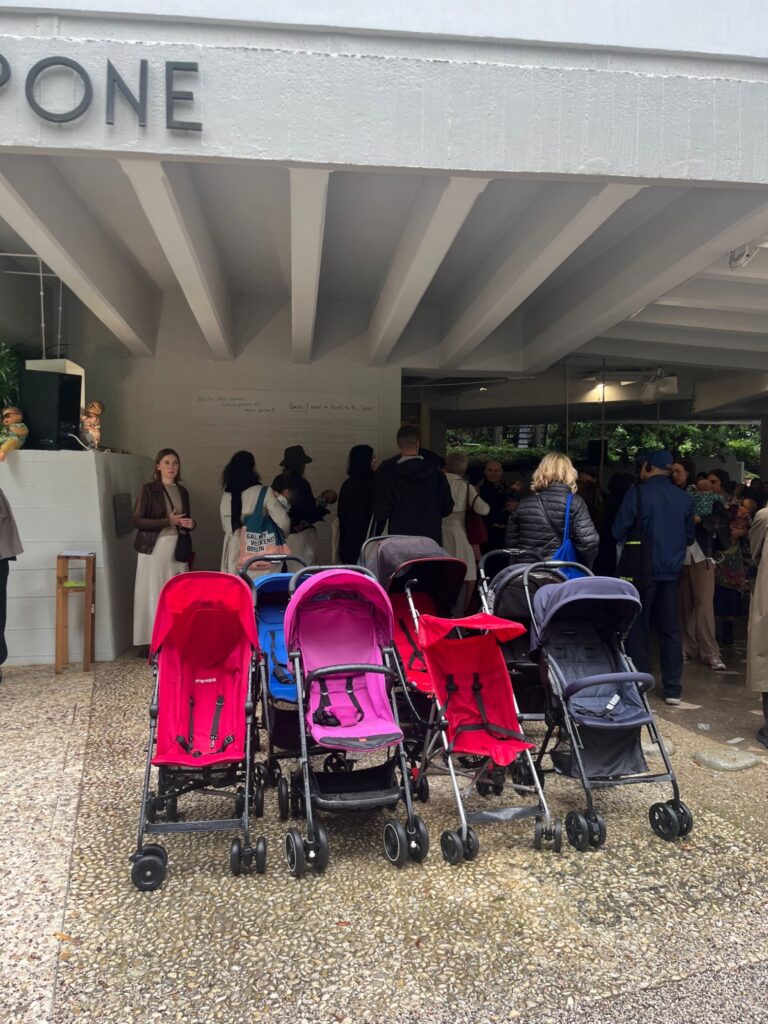
The work starts as I approach the pavilion and see 7 empty buggies parked in front. This simple intervention triggers a whole chain of compulsive performances in me as a visitor: I soften my chest, sharpen peripheral senses and recalibrate expectations, anticipating dispersed rather than focused attention, as I prepare to share space with people with different needs than the average adult art viewer. I get closer and see about half of the adult people inside carrying babies. I giggle, their awkward postures are shockingly different from the self-assured and composed art professionals crowding the preview. Quickly I realise that most of these babies aren’t alive, but are some of the 200 dolls which are part of the artwork. As I enter the pavilion I find a central table with many of the dolls placed on it. I approach one, but a pavilion host proposes another doll for me to carry. Another giggle, we might make ourselves available for childcare, but that doesn’t mean we get to choose our child, or in this case, doll. The dolls are heavier than they look: 6 kg, roughly the weight of a 4 month old human. The weight explains the awkward postures and it gives my body something to adjust to. Another giggle: indeed we might dream of redistributing childcare, but building a care relation with a child takes time and effort, and so does figuring out how to carry one of the dolls in Grass Babies, Moon Babies. My walk through the pavilion continues with more giggles, and a concluding one is prompted by the glimpse of separation anxiety I feel when I have to leave the doll.
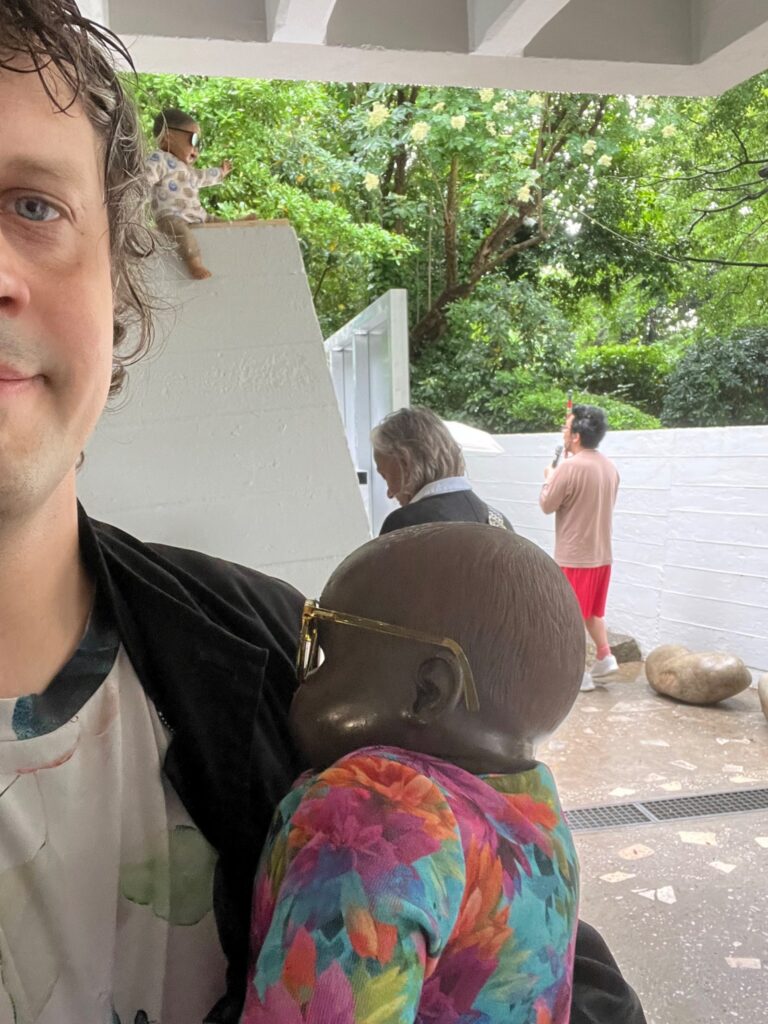
Separationanxiety at Grass Babies, Moon Babies by Ei Arakawa-Nash. Photo Adriano Jensen
Ei Arakawa-Nash refers to care as a form of labor that is “socially distributed and historically gendered”. Witnessing and being invited to participate in this collective performance of care in the imposing architectures of the biennale definitely reminds me of where and when I did not expect carework to take place. If Anne Imhof managed to tease out and stage unflattering desires in the visitors of Faust pavilion in 2017. Then Ei Arakawa-Nash is charming us to expose ourselves and see each other in a more gentle utopic light. The dolls are tools that organise rehearsal-performances in and by the visitors. I was very impressed how well this work works without paid performers. Don’t get me wrong, for sure I wish for more and better paid performers. But most artists and curators don’t have access to the funding for that. And maybe somewhere between its fluxus humor and ‘sculpture-as-tools-for-participatory-rehearsal-performance’ Grass Babies, Moon Babies expands the playing field and (re)open doors for what the medium of performance can do in exhibition context.
Possibly an inverted version of ‘participatory-rehearsal-performance’ would be studio practice itself as a public performance. On my last night in Venice I met Merike Estna, who in the Estonian Pavilion will realise one huge painting throughout the 6 months of the biennale. She told me that she will live in Venice with her partner and child and go everyday to the pavilion to paint in public. I am curious about how this entanglement of care responsibilities, practice, and place will play out. And whether the 6 months of practice-as-public-performance or the resulting painting will be appreciated as ‘the work’.
I did not have a chance to visit the pavilion: The strike of course, but more importantly the many pavilions with live performance, which extended the duration of standing in line and the duration spent with each proposal. Live and life got in the way.
They also got in the way of this writing. Maybe with some distance I can approach the immediacies of the live performance proposals.
Part 2/2 – September 10th 2026
After the hottest summer on record, the ‘acqua alta’ (seasonal flooding of the Venetian streets) arrives demonstratively early. And I return to write about the three pavilions that involve live performance. In this case I think complexity correlates with labour-power, which (hopefully) correlates with budget. Because of this I will start with the pavilion that requires the smallest budget to run and end with the one that requires the biggest (None of them are cheap!).
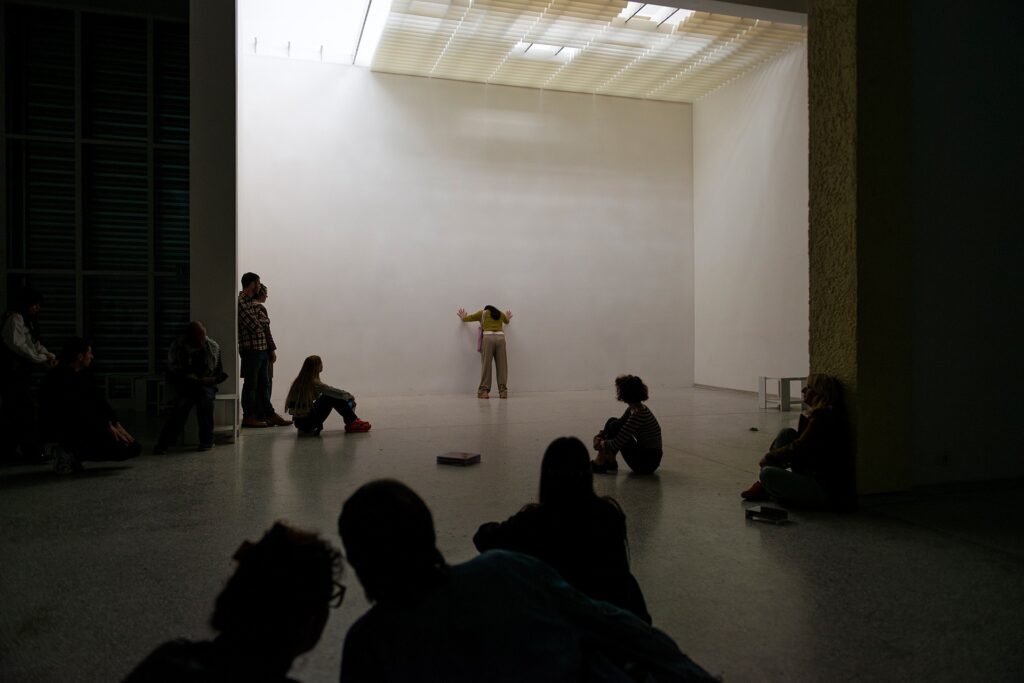
Dries Verhoeven’s The Fortress in the Dutch pavilion is structured around a 25 minute solo performance starting once an hour, on the hour. Just like in a theatre one group of visitors sees each performance together, from beginning to end, except here you can’t reserve a ticket, but have to stand in line. Once inside light slowly fades away as steel shutters seal all windows and doors. The bright modernist architecture turns into a gloomy cage. The pavilion is bare except for some scattered stools and old Venice Art Biennale catalogues molded into transparent resin blocks. Where Anne Imhofs Faust, (2017) stimulated unflattering desires in the visitors by adding layers of obstacles between visitors and artwork, The Fortress inverts the gesture and (symbolically) locks the visitor in with/inside the artwork. The symbolism appears too thick for me to feel/think anything much about it. Once all doors and windows are sealed an incognito performer growls: “STOP!” (growling is a vocal technique famous from music genre death metal: rough, raspy and ripe for rage). The performer acts as if nothing happened. Smiles kindly and disarmingly, but then again: “STOP IT!”…. “HELP!”…. “HELP YOURSELF!”. The performance unfolds as a growling monologue often structured in such A / A B mini-accumulations. At some point the performer takes off her pants and lies on the floor, growls more before putting them back on and stepping on one of the stools and taking off her t-shirt. Growls more: “ENGAGE!”….”LOVE”….”LOVE YOURSELF”, puts back on the t-shirt. and growls more. Eventually light returns as the steel shutters open and we leave The Fortress.
I feel hesitant writing about this work. It is full of agreeable statements, and I struggle to find the questions. As if I am being taken by the neck, to look in a given direction, when I expected to look around freely. Well that might actually be the point of the work. The ignorance that goes with a certain illusion of freedom. Let’s state the obvious: the title must refer to ‘fortress Europe’ an image used when criticising the fortification of the European Union, especially in relation to the militant policing of its borders by Frontex, the European Border and Coast Guard Agency. The Fortress parrots how Europe’s promises of modernism, art and humanism have developed from an optimistic post-war outlook to a hollow and horrible self-deception, a distraction from the dehumanizing exclusion enforced in its name. A self-deception that instrumentalises art and that ‘we’–visitors to the Venice Biennale–are locked inside. Absolutely, I agree, and then what? And how does that observation resonate with a rotating cast performing the same monologue 200 times over 6 months? When 10-15 years ago ‘delegated performance’ proliferated, and artists like Tino Sehgal effectively hired performers as readymades to perform themselves in gallery spaces, I think it would have felt emancipatory to assume ‘appointment based schedule’ instead of ‘opening hours’ performance. Back then Simon Asencio and I were experimenting as Galerie with how to integrate medium-specificity into the (infra)structures of immaterial works when presented in visual arts contexts (how to let the dance behave like a dance instead of asking it to behave like a sculpture). But even if The Fortress allows the 25 minute solo performance to behave like a 25 minute solo performance, there is something life-less about it. Maybe it’s too tightly composed: the same solo passing through different performers bodies and addressing different groups of spectators as if untouched rather than evolving somehow through such a spectacular number of presentations?
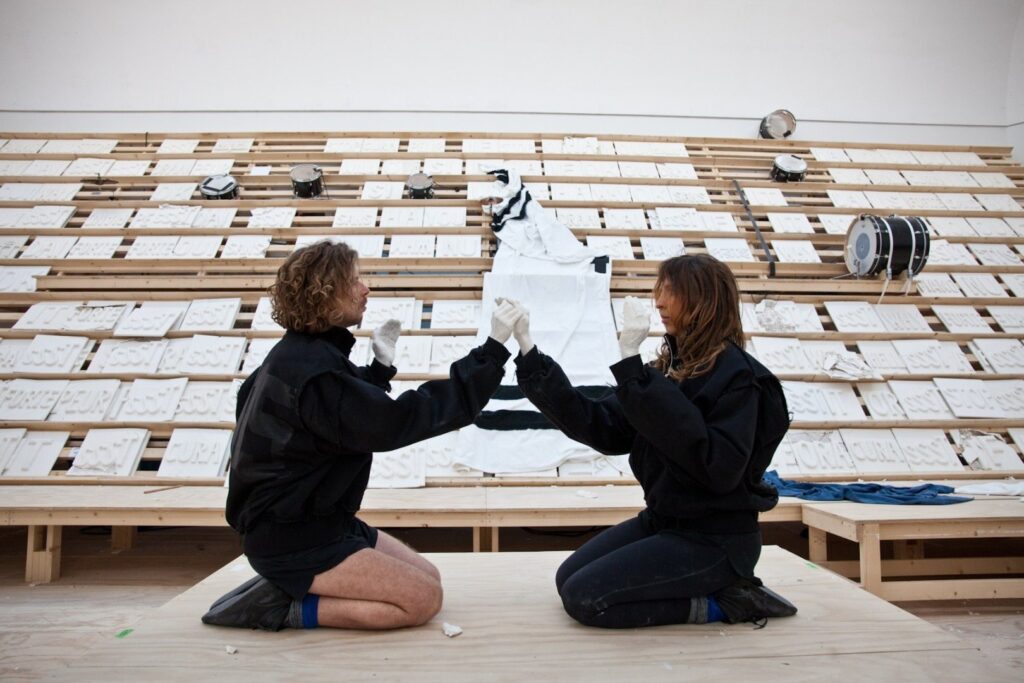
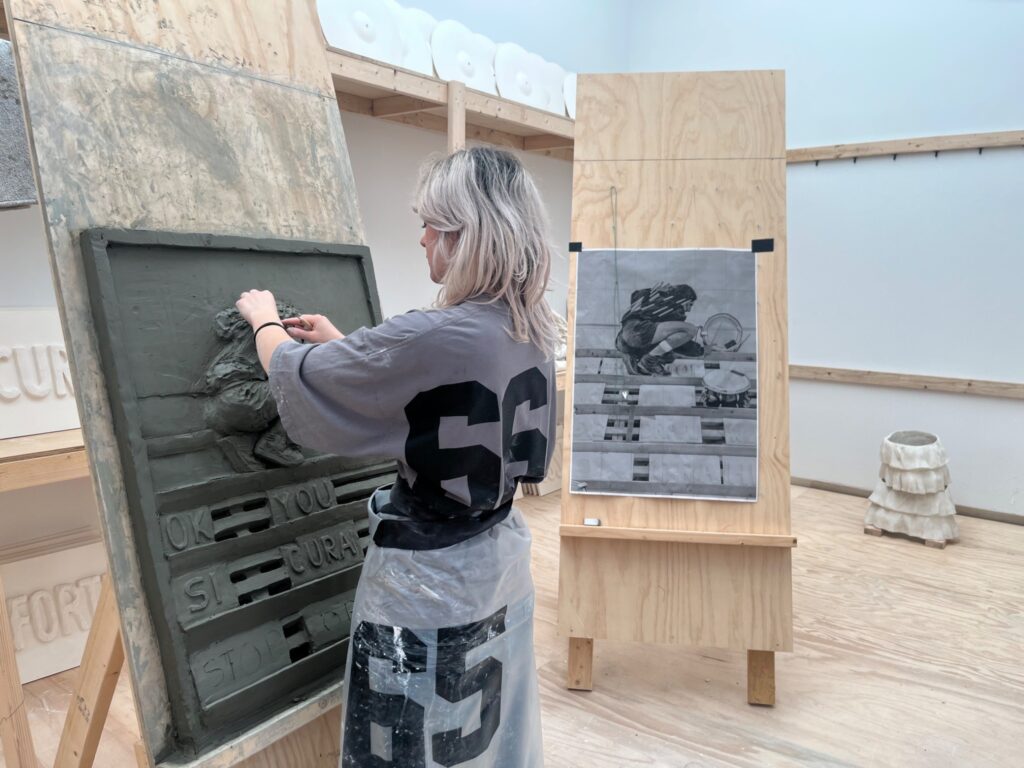
Another proposal for appointment based performance, however combined with an open installation, is Miet Warlop’s IT NEVER SSST for the Belgian pavilion. Like the other performance proposals it starts with sweating in a line. This particular line is soundtracked by drumming and yelling leaking out from the performance inside. Once I enter, the pavilion appears as if going through reconstruction: raised plywood floors, benches and a big wooden scaffolding leaning on the back wall as a reclining stage, which is also the support structure for hundreds of plaster plates embossed with single words combined in a great many ways throughout the performances. I visit an adjacent room where a photograph from an earlier performance is being reproduced as a relief, similar to those that can be seen ornamenting old buildings in the city. Maybe ‘post-performance’ is as ancient as the reliefs of Paleolithic Egypt, Mesopotamian Iraq, or perhaps (at least) as Byzantine Venice?
Shouting and drumming breaks out as the next performance starts: Performers roam, drum, shout, climb and throw the one-word-plaster-plates, the energy is high, and the rhythms relentless: Drums beating. Shouting. Moving together. Keeping it moving. In a duet two performers use plaster hands to do clapping games with each other, the plaster breaks and crumbles as they ‘clap’. Then more plates are thrown from performer to performer combined with more shouting and drumming. Everything feels close-up and visceral, and angry in a joyous way. It doesn’t go anywhere, but it is going, going and going. The mere effort of waiting in line to get in, makes it less appealing to get out again quickly. And the intensity makes it undesirable. Drums speak to my heart, the vibration of sound shakes my skin. I didn’t know I needed this. I wonder if this is what Dionysian theatre rituals felt like in ancient Greece: Ecstatic communions. I don’t understand any of the words they shout, but it doesn’t matter. This is a factory of vibration and rhythm. It is also the performance proposal that mostly resembles a conventional western dance theatre performance in structure and feeling; predominantly frontal, intense liveness, delivered efficiently. As if it’s the forever open Belgian theatre in Venice, that you can enter from the artists entrance and sit on the side of the stage and take in the sweat and vibration of performances being churned out. Is this bourgeois escapism from a burning world or is it noise therapy to reset the critical faculties? I don’t know, but I leave feeling energised.
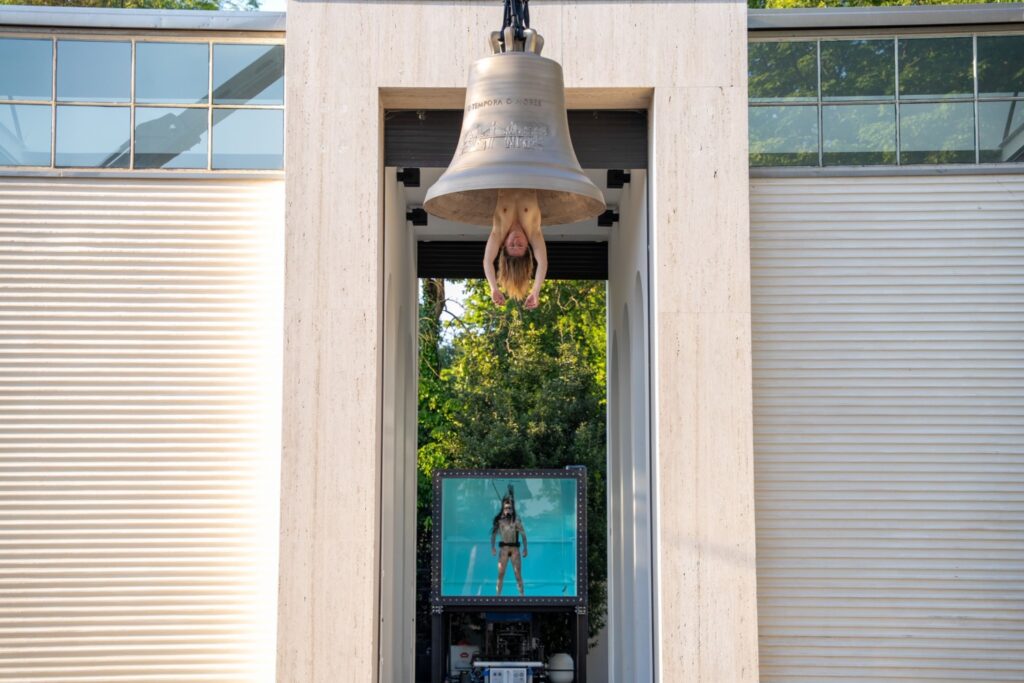
Finally I arrive to SEAWORLD VENICE by Florentina Holzinger. Having followed her practice since we both studied at School for New Dance Development (SNDO) 18 years ago, I have been amazed by how Holzinger can upscale her work while keeping it fresh. From her research of the spectacular body in collaborations with Vincent Riebeek (if I remember correctly both title and concept of their first collaboration in school was: we want to be number fucking one to every fucking body all the fucking time) which lead to a series of collaborations between the two of them that toured professionally: Kein Applaus für Scheisse, Spirit, Welness, Schönheitsabend.
From there she upscaled and created a series of group pieces for five to twelve performers (Recovery, Apollon & TANZ), Instead of a very spectacular duo, the audience was now presented with an excess of spectacular acts by a group of female performers. These acts were held together by reflections on relations between spectacle, body discipline and dance history. And I couldn’t keep track of which performer did which spectacular act, a refreshing challenge to many performances at the time (not only Vincent and Florentina’s) which seemed to propose the ‘specialness’ of the performer as both means and ends of the work.
After this series Holzinger upscaled again for Ophelia’s got talent, Sancta and A year without summer as helicopters, a swimming pool on stage and robot dogs mixed with more extreme body acts and musical songs presented at even bigger theatres and operahouses.
Now Holzinger (and her team) is experimenting with leaving the theatre. In Venice they propose both SEAWORLD VENICE in the Austrian pavilion and site specific satellite presentations categorised as Etudes.
SEAWORLD VENICE is somewhere between an architecture and an ecosystem, organised by a complex choreography of temporalities. As you enter you turn your back to the huge bell which is rung once an hour as a naked performer throws her body against its hard metal interior; in front of you, another performer with a diver’s mask is suspended in a tank of purified urine, sometimes standing and looking out over us, sometimes sleeping. On your sides two pools of purified urine, one with a slowly revolving giant weather vane inspired pole and on the other side a jetski which a performer once an hour rides in frenetic circles like a spectacular watertechno rodeo. On either side of the central tank are two toilets, where visitors provide urine to the water purification system that supplies the pavilion with water. The toilets are tended by performers acting as cleaning ladies who instruct the visitors how to donate. Finally one chamber between the weather vane and the right toilet hosts the repeatedly breaking water purification system, occasionally releasing unidentified brown substances. And the last chamber between the jetski and the left toilet has a platform where one of the performers practice shooting bow and arrow with her feet.
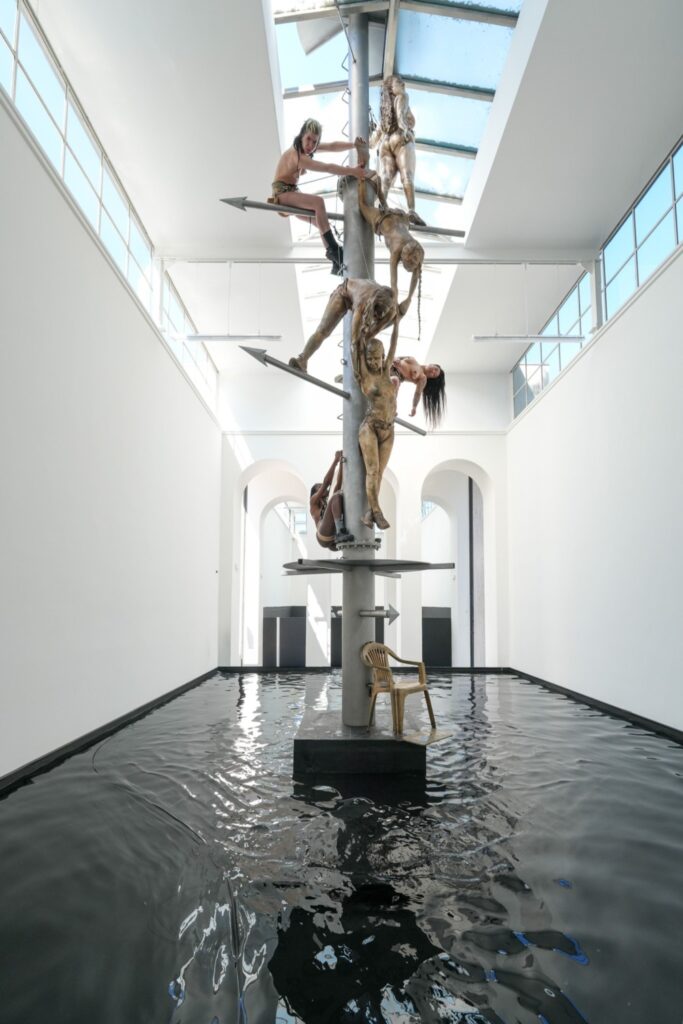
Standing on the central platform, I start to think of the whole thing as a kind of broken compass or secular metabolic church: the suspended body establishes a continuous, almost timeless present; the bell punctuates; the revolving pole spirals between continuity and repetition; the jetski accelerate and interrupt the slower rhythms and the quotidian coordination and labour of the cleaning ladies keeps it all together. What moves me is the persistence of collective effort. The performers circulate roles from jetski to cleaning ladies to big tank to bell and so on. As I write this, a naked performer is likely still submerged in purified piss and in 26 minutes another will be throwing her body against the bell, hour after hour, day after day, for the duration of the Biennale. This unforgiving duration turns the spectacular body into something else: not an exceptional body presented for consumption, but a disciplined, resilient and organised body participating in an ecosystem of bodies, technology, labour, care and waste. Importantly, my viewing body is implicated too. Inspired by Daniel Blanga-Gubbay’s notes on spitting, I would say that not only my gaze, but my body is ‘circluded’ by the work: I am not simply extracting experience from these bodies, but entering a system in which attention, time, urine, water, labour and care are continuously exchanged. The fact that the water-cleaning system seems to break down daily–according to the toiletladies “it’s because someone, probably a guy, has once again shat in it”–is not an unfortunate glitch that sits outside the work. It rehearses the impossibility of a seamless ecosystem, and perhaps that is precisely where SEAWORLD VENICE becomes most interesting: as a performance-exhibition that asks what bodies can be and do together after religion, patriarchy, capitalism, climate crisis, pornography and colonialism, without imagining that any of these conditions can be purified away.
And voila, hereby my dispatch from Venice. Please don’t hesitate to reach out if you want to think together about any of this. Especially if you disagree with me.
xoxo,
Adriano
Adrianowj at gmail.com