“People displace objects.
Objects displace materials.
Materials displace themselves.”
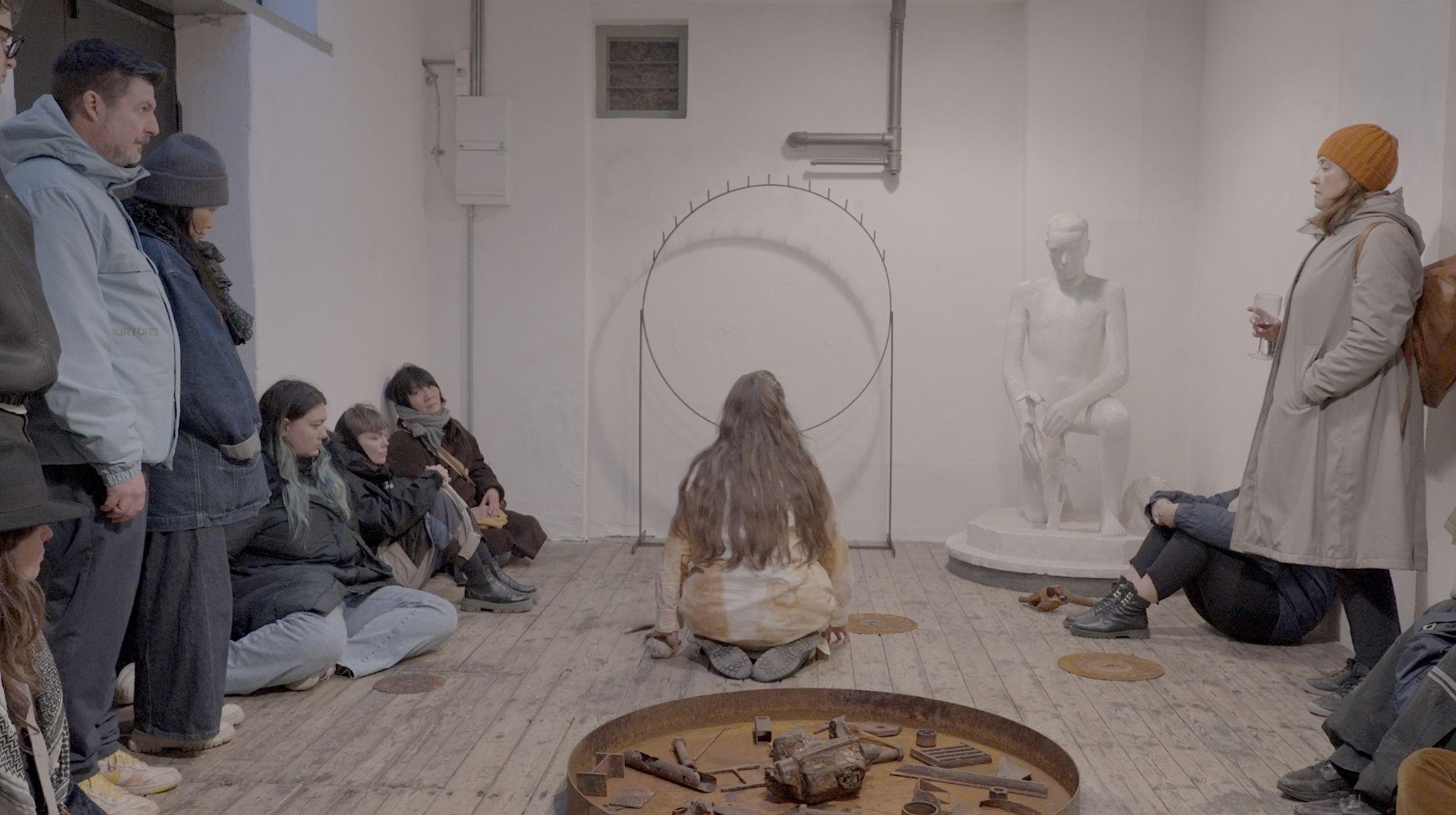
These sentences were repeated by the artist/performer (Astrid Randrup), creating a meditative and incantatory atmosphere. The real magic, for me, was that the entire performance was exactly grounded in those phrases, with no need for more decoration or less. The performer’s clear, minimal suggestions in each scene led the audience to imagine multiple spatial and temporal dimensions, allowing my flight of thoughts from an exchange economy to childhood play alongside construction sites, to the ancient iron tribes, and to the current industry, all mediated through iron.
Exchange
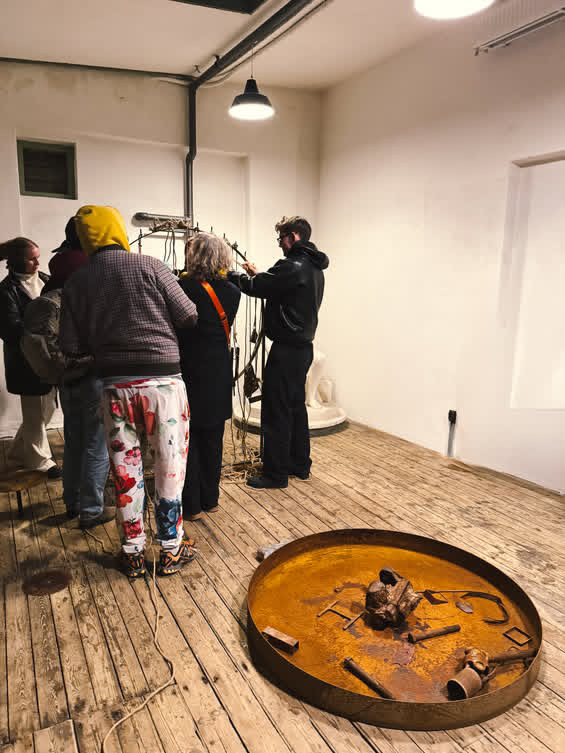
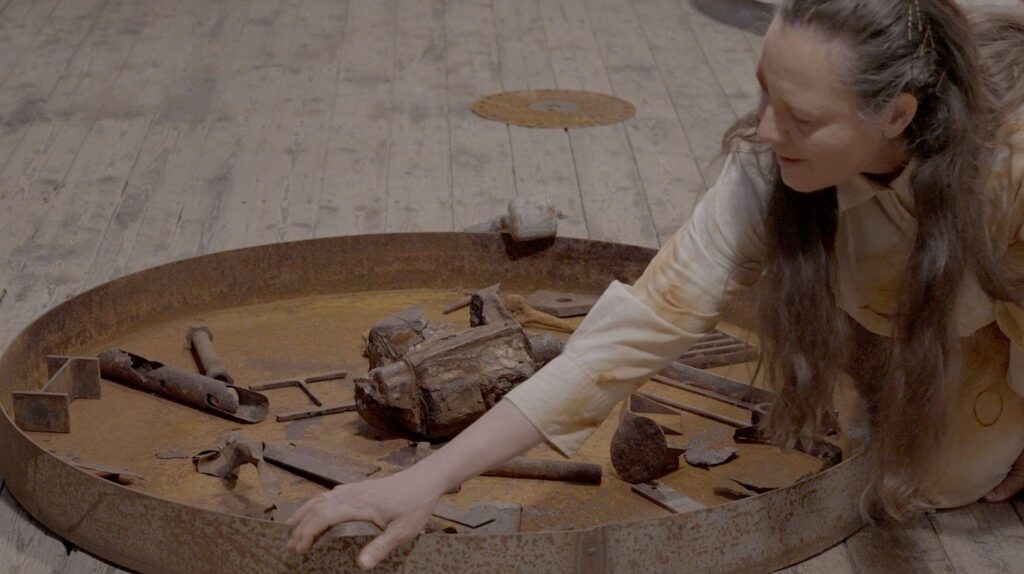
Upon entering the space, the performer was seated at one end of the room. In the center, various rusty, dark-orange iron objects were placed on the circular rusty iron plate. After repeatedly uttering the sentences, the performer began handling the objects, slowly smearing them, creating friction between the iron surfaces. She then handed the object to the audience. The moment she replaced one object given to one audience for another given to someone else, something magical occurred. Every audience member began exchanging their iron objects with others, sometimes actively moving around the room. The small act of displacing each object became a play of exchange, a pleasure of giving and receiving objects regardless of the size or value, and fostered a sense of recognition among the audience members.
Travel
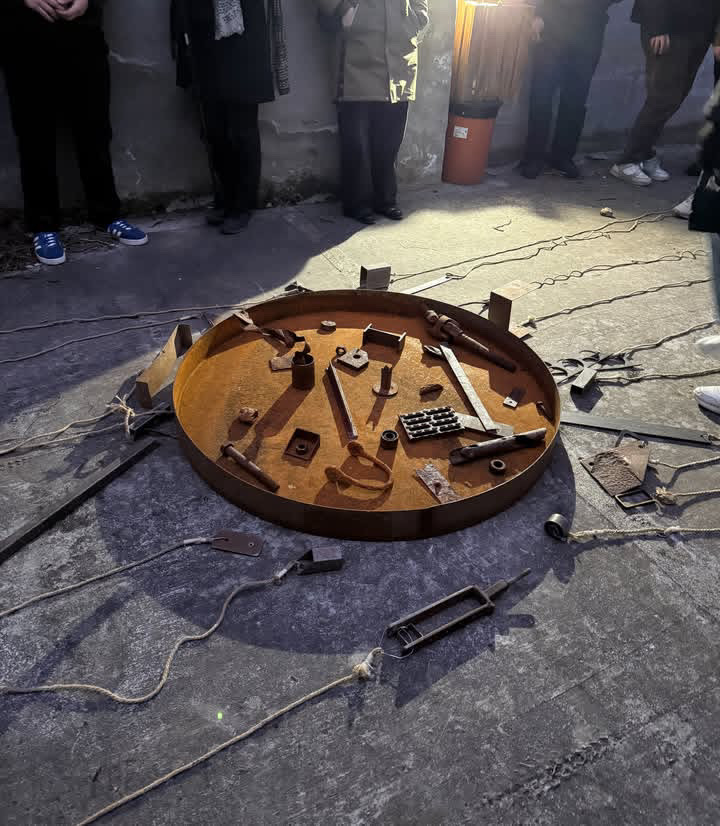
In the second scene, the audience carried their iron objects and travelled farther out into the yard. Another rusty iron plate was set up, surrounded by objects tied with ropes. After placing the objects on the plate, the audience held each rope and pulled it, sensing the friction between the object and the ground while listening to the sounds produced alongside those of other audience members.
Flight of Thoughts in Twilight
As we moved on, we formed a large circle as a group, walking, dragging, and shaking our objects. It felt as if we were a group of experimental sound artists exploring new sounds created with iron, or perhaps we were just playing like children. This happened to coincide with twilight, a magical time between day and night. I don’t know whether the play or the twilight itself recalled my childhood memory. The image dates back to the beginning of urban development. Streets were being paved with concrete and asphalt. My neighbours began renovating their old house, signalling the onset of economic growth. My friends and I were curiously exploring the construction sites in the neighbourhood, which were empty in the evening after the workers had left. We collected discarded objects like iron screws and pipes and used them as our new toys until each of our moms called us home for dinner.
We Play Iron. Iron Plays Us
Surprised by the sudden occurrence of memory, I distanced myself from the group and looked around. I questioned myself. What were these iron objects doing, and how were they reshaping my existing understanding and experience of iron? Iron is not an innocent material at all. It often appears as a desolate bone structure in construction. Considered one of the most important materials in modern industries, iron plays a crucial role in shaping global infrastructure and the economy, driven by continuous resource exploitation, global outsourcing, and the transportation of goods across the planet. Historically, the knowledge of iron melting and the manufacture of iron artefacts enabled tribal societies to engage in active warfare. The iron sword, much stronger than a bronze sword, was a symbolic instrument that transformed tribal societies into a centralized, patriarchal kingdom.
However, in this performance space the audience engaged playfully with iron objects. Each person played with the object both individually and while resonating with others. The iron in this space seems so distant from its association with industry and warfare. I recalled the sentences I had heard earlier: Since the dawn of human history, “people have displaced objects, objects have displaced materials, and materials have been displaced” by humans or by themselves through their affective agency. The displacement is not only for war or capitalist gain, but encompasses a broader spectrum of interactions, and what I witnessed among the audiences can be a resemblance to that.
Humans used, or were being used by, iron throughout history creatively and practically. Human ancestors were very good at circulating and disseminating their new, creative, practical, and (sometimes) aesthetic inventions across continents and seas. Imagine how iron art appeared in one region and then spread to the others, creating similar artifacts but with different styles. Throughout the performance, the audience exchanged iron objects and let others try them. The sound of iron objects played by the audience was individually created but polyphonic. This exchange may be akin to how our ancestors shared knowledge of iron smelting and the manufacture of iron artifacts – through gifting and communal experiences.
Emergence of the relational and ontological turn in philosophies and anthropologies, various thinkers have tried to dismantle the Western modern human-centered thinking and the separation of ‘subject’ and ‘object’ by revealing the ‘agency’ of non-humans and how cultures are shaped by constant interaction with more-than-humans, including not only other species but also things and matters. (Janne Bennett 2010, Tim Ingold 2010, Daniel Miller 2010, among others). Artists who have always had a deep relationship with materials are the ones who already embody and practice this knowledge. The specialty of this performance was that it generously invited the audience to engage with the irons in their own way, and together as a group. This experience reminded me that there was another attitude toward objects and materials than the dominant industrial or warfare ways. Therefore, we could better appreciate and enchant the different ways of relating to materials, objects, and others.